


Wednesday, July 1, 2026
Home Blog Page 246

New corporate governance era for Nigerian private companies: Navigating the impact of FRCN Act 2023 for Compliance, Leadership

0

Introduction

Until recently, most Nigerian private companies operated with a certain comfort. They were growing, compliant with CAC filings, and largely left alone by federal regulators unless they were in heavily monitored sectors like banking or oil. For many founders, the phrase “corporate governance” felt like boardroom jargon reserved for the Dangotes and the Zenith Banks of the world.

That changed in 2023. What caused the sudden shift? The Financial Reporting Council of Nigeria (Amendment) Act 2023 (“the Act” or “Amended Act”).

This Amendment didn’t just tweak some obscure definitions; it redrew the map. It expanded the category of Public Interest Entities (PIEs) to include many private companies that previously operated far from regulatory spotlight.

As a result, if a company holds a license from a regulator (say in logistics, oil & gas, telecoms, or agriculture), or if the company’s revenue is N30 billion or above a year, such a company is now a PIE. That means such a company is expected to maintain a high standard of governance, and report it annually.

For many founders and directors, this shift feels like moving from a quiet back road to a busy highway, complete with speed limits, traffic rules, and a regulatory patrol. It’s not just about being profitable anymore; it’s about how you lead, report, and govern.

This article breaks down what this new reality means for Nigeria’s private sector. We’ll explore how the 2023 Amendment changes the rules of the game, what private companies must now do to always stay compliant, and how this regulatory evolution could actually become a competitive advantage, if approached strategically.

Background to the FRCN and the Amendment Act.

The FRCN’s Mandate: More Than Just Number

The Financial Reporting Council of Nigeria (FRCN), established in 2011, is much more than a financial watchdog. Think of it as Nigeria’s referee for how companies present their financial health and leadership ethics. It took over from the old Nigerian Accounting Standards Board and expanded its scope, overseeing how companies report their numbers, audit their books, manage their actuaries, and perhaps most crucially, how they govern themselves.

Through its Directorate of Corporate Governance, the FRCN doesn’t just set rules, it sets the tone for integrity in leadership. It’s like having a compass that points businesses toward transparency and accountability, rather than letting everyone follow their own interpretation of “good governance.”

The Nigerian Code of Corporate Governance (NCCG 2018): A Flexible GPS

In 2018, the FRCN rolled out the Nigerian Code of Corporate Governance (NCCG). Now, let’s be honest: the word “code” makes it sound like a set of rigid commandments. But that’s not the case here. The NCCG is more like a GPS, you enter your company’s destination (sustainable success, credibility, ethical operations), and the code offers multiple routes to get there. It is for this reason that the Code adopted an “apply and explain” model. That means companies aren’t expected to follow every rule blindly, but rather to apply the principles in a way that makes sense for them, and then explain their reasoning in their annual Corporate Governance Report.

For example, a family-owned logistics firm in Aba might explain why it hasn’t appointed an Independent Non-Executive Director yet, but also share how they’ve structured oversight differently to ensure accountability. It’s about being intentional and transparent, not perfect.

Key Changes in the FRCN (Amendment) Act 2023

When the Amendment Act dropped, it felt to many private company executives like waking up to find their quiet street now had a toll gate, a speed camera, and a traffic officer asking for their license and registration. For some, it came as a memo from legal or compliance units/departments of private companies; for others, it was a nudge from their auditors: “Hey, you know you’re now considered a Public Interest Entity?” Here’s what actually changed, and why it matters to you, whether you’re running a 40-year-old family business or a fast-growing fintech startup.

Expanded Definition of Public Interest Entities (PIEs): The Game-Changer

Previously, the PIE label was reserved for publicly listed companies and major players in the finance space. The private companies, assumed they were spectators, not players, in the governance compliance league. But now? Not anymore. Under the new law, a private company is a PIE if:

i. it holds a license from a government authority (think NCC for telecoms, NUPRC for oil & gas, or NAFDAC for food processing).

II. Its annual turnover is N30 billion or above.

Enforcement Powers Strengthened: Not Just Talk Anymore

Section 61A of the Amended Act enables the Council to leverage the capabilities of law enforcement for their activities such as investigations, enforcement actions, and ensuring compliance with financial reporting and corporate governance standards. Fortunately, this isn’t about fear-mongering. It’s about awareness. If your company ever been caught off guard by a tax audit, you know that proactive compliance beats reactive scrambling every time. The Council can now prescribe penalties above N5,000.00 through a regulation to be issued by them from time.

Mandatory Corporate Governance Oversight: No More “Optional” Alignment

Before the amendment, it was easy for private companies to treat the NCCG like a suggestion box.

“We’ll get to it, eventually,” many would say. Not anymore. The Directorate of Inspection and Monitoring is now statutorily required to make sure companies comply with the NCCG 2018. This means that private companies will need more than a well-meaning board retreat, they will need a strategy for aligning their governance model with the expectation of the Code and the Amended Act.

Annual Governance Reporting

Going forward, companies that meet the PIE definition must file an annual corporate governance compliance report. This report needs to show:

I. Which NCCG principles the company adopted in the year under review;

II. How the company applied them;

III. And if the company didn’t adopt some, why not?

It is important to reemphasize that the private companies are not being judged for not being perfect, they are being assessed on whether they are being thoughtful, responsible, and transparent. Thus, we recommend that companies start treating their governance records the way they treat their audited financials. It might feel like extra work, but it can save private companies from costly penalties or reputational damage down the road.

3. Implications for Private Companies in Nigeria

For many private company founders, this new compliance era feels like a curveball. They built their business through grit and sacrifice. Now, seemingly out of nowhere, they are being asked to align with a national governance framework they hadn’t really thought about. Let’s break down what this means for such business owners and how they can turn it from a burden into a boost.

3.1 Immediate Compliance Obligations: Ready or Not, It’s Time

If your company meets the new Public Interest Entity (PIE) criteria, whether because of its license or turnover, here’s what’s expected:

I. Submit annual governance reports starting from the 2023 financial year

II. Adopt the “apply and explain” model of the NCCG 2018. That means you don’t just follow the rules, you explain how and why you applied them.

III. Keep records of the board decisions, risk assessments, and other governance matters like your life depends on it (because your business reputation might).

3.2 Board Composition and Committee Requirements: Time to Rethink the Roundtable

One area where the FRCN is gently nudging private firms is board structure, particularly around Independent Non-Executive Directors (INEDs). Here’s what the NCCG 2018 suggests:

Governance and Nominations Committees. Members of the committee should be NEDs, and a majority of them should be INEDs “where possible”, while the Chairman should be a NED.

Remuneration Committees should follow a similar pattern, and it’s “desirable” that the Chair is an INED.

Audit Committee. Similarly, members of the committee should be NEDs, and a majority of them should be INEDs “where possible”.

Now, there is no need to panic as the above provisions have made the principles aspirational standards. However, if a private company wants to demonstrate maturity and credibility to investors, lenders, or regulators, these are worth aiming for.

3.3 Industry-Wide Effects: No One’s Really Exempt Anymore

Wondering if this applies to your industry? Chances are, your company is on the radar now. Let’s take a look at who’s being affected

I. Oil & Gas: If you’ve got a marginal field license or a downstream operation, you’re likely in.

II. Telecoms: NCC-licensed players, even medium-sized ones, are now PIEs.

III. Logistics & Transport: Your revenue and your NPA or NRC license might qualify you.

IV. Manufacturing: If your turnover is healthy or you require regulatory oversight, welcome aboard.

V. Fintech & Digital Services: Central Bank license + big revenues? You’re in.

VI. Agribusiness: Exporting, processing, or licensed large-scale farming? You guessed it, PIE.

4. Legal Context: A Shift from Judicial Immunity to Statutory Compliance

For years, many private companies operated under the assumption that they were shielded from the oversight of the Financial Reporting Council of Nigeria (FRCN)—as if protected by a legal force field. And to be fair, that assumption wasn’t baseless. In the landmark 2012 case Eko Hotels Ltd. v. FRCN, the court ruled that unless a company met the definition of a Public Interest Entity (PIE), it fell outside the Council’s jurisdiction. That decision quickly became an unofficial doctrine in corporate boardrooms across the country. But with the passage of the FRCN (Amendment) Act, 2023, the landscape has changed. The law now makes it clear: many private companies do, and in fact, qualify as PIEs, either because they are licensed by a government agency or because they generate annual revenue of ₦30 billion or more.

What this means in practice:

The 2012 court decision no longer offers protection to private companies that now fall within the expanded PIE definition.

The FRCN no longer needs to go through the courts to enforce compliance.

If your company meets the PIE criteria, your governance practices are now under the Council’s direct oversight.

5. Why This Shift Matters

This shift from judicial immunity to statutory obligation is not about punishment. It’s about recognizing the growing influence of private companies in shaping Nigeria’s economic future. When a private firm with ₦30 billion in revenue or a national license makes a governance error, the ripple effects are real; on jobs, supply chains, and investor confidence. We’re no longer in the era where only banks and listed companies matter. The FRCN Amendment Act 2023 has simply acknowledged what was already true: private companies can and they do have tremendous public impact, and governance should reflect that.

6. Conclusion: A Compliance Turning Point for Private Companies.

As businesses grow and gain regulatory significance, their responsibilities evolve beyond profit-making to national economic contribution. The FRCN (Amendment) Act, 2023 marks a turning point for private companies, introducing higher expectations for governance and accountability. While compliance may seem burdensome, it offers a path to stronger structures, greater transparency, and lasting trust, an essential asset in today’s competitive business landscape. If anything, it’s a chance to professionalize your house, inspire confidence, and scale with integrity.

Written by Emeka Ogenyi (LP), Lead Partner, ThinkField Law, can reached at: Info.thinkfieldlaw@gmail.com Meogenyi@gmail.com

FRCN Emeka Ogenyi


BREAKING: EPL: Liverpool forward, Diogo Jota dies in car accident days after wedding 

0

English football team, Liverpool forward, Diogo Jota, has died in a car accident in Spain.

According to the Daily Mail, the 28-year-old was travelling in the vehicle with his brother, Andre.

It is reported that the car went off the road on the A-52 in the province of Zamora.

Jota’s tragic passing comes only two weeks after he got married to his long-term girlfriend, Rute Cardoso, in Porto.

The forward was part of the Liverpool squad that won the Premier League title in May during Arne Slot’s first season.


Nigerian Senate lauds ICPC for adherence to federal character recruitment 

0

The Nigerian Senate has lauded the Independent Corrupt Practices and Other Related Offences Commission (ICPC) for its commendable and consistent adherence to the principles of Federal Character in the composition of its workforce and distribution of positions within the organisation.

In a statement by the commission’s spokesperson, Demola Bakare, on Thursday, this recognition was given on Wednesday at the National Assembly in Abuja by the chairman of the Senate Committee on Federal Character and Inter-Governmental Affairs, Senator Allwell Onyesoh, during the appearance of the ICPC chairman, Dr. Musa Adamu Aliyu, SAN, and his management team before the committee to present the commission’s staff profile and deployment statistics.

Speaking after the presentation, Senator Onyesoh expressed deep satisfaction with the commission’s transparency and inclusive practices.

He praised the ICPC for demonstrating a clear commitment to fairness, equity, and national representation in its appointments and promotions. He urged other ministries, departments, and agencies (MDAs) to emulate the commission’s exemplary model.

In his words, “ICPC has shown that due process is not only possible but also achievable. What you have presented today gives us hope that we still have institutions and individuals committed to building a better Nigeria. You have honoured this institution by being open and transparent about how you conduct appointments and elevate officers to high positions.”

Senator Onyesoh lamented that several MDAs deliberately avoid appearing before the committee, largely due to a lack of transparency and poor compliance with federal character requirements.

He also noted that many of those who have appeared before the committee have failed to meet basic expectations, contrasting them with the ICPC’s outstanding performance.

The senator went further, “Whenever we encounter challenges with any MDA regarding compliance with federal character principles, we will direct them to you so they can learn from your example. I am very pleased with the level of openness and accountability that ICPC has demonstrated today. It is truly worthy of emulation.”

Other members of the committee also commended the ICPC, noting that the commission has distinguished itself by maintaining a balanced and transparent workforce. They described the ICPC’s nominal roll and manpower distribution across the six geopolitical zones as unparalleled among government institutions.

Presenting the commission’s personnel statistics, the ICPC chairman, Dr. Musa Adamu Aliyu, SAN, disclosed that the commission currently has 1,163 staff members, fairly distributed across the six geopolitical zones as follows: North Central – 19%, North West – 19%, North East – 16%, South South – 16%, South West – 16%, and South East – 14%.

The ICPC Chairman further revealed that the commission has ten directors overseeing its various departments, with nine substantive directors and one in an acting capacity, also equitably distributed across the six zones.

According to Dr. Aliyu, “The Commission, as Nigeria’s leading anti-graft agency, is proud to be practicing what it preaches. We are fully committed to upholding all extant rules and regulations, including the Federal Character Balancing Index, and we have been repeatedly commended by the Federal Character Commission for our consistent compliance.”

He reaffirmed the commission’s dedication to promoting equity and inclusiveness, noting that these values are central to its mandate of fostering integrity and good governance in Nigeria.


BREAKING: 2027: Atiku, Secondus, others exit PDP

0

2023 Presidential candidate of the People’s Democratic Party, Atiku Abubakar, former Chairman of the Party, Uche Secondus, and ex-Senate President David Mark have exited Nigeria’s leading opposition party ahead of 2027 elections.

Their decision was contained in a communique issued on Tuesday after a close day in Abuja.

See communique:

THE GAME IS ON…

“COMMUNIQUE OF THE MEETING OF CONCERNED LEADERS OF THE PDP HELD AT TRANSCORP HILTON HOTEL ABUJA ON

TUESDAY, 1ST JULY 2025

PREAMBLE

The meeting of Concerned Leaders of our great party, PDP, was called to discuss the disturbing condition the party has been sunk into.

Since our loss in the last presidential election and the exit of Dr. Iyorchia Ayu as National Chairman, our dear party has never been the same again.

Vested interests from within and the irresponsible actions of the APC-led federal government, which has been using state institutions to stifle and destroy the democracy, know no bounds!

The inability of PDP leadership to lead the party by its constitution, rules, and regulations led it into a chaotic and undisciplined party!

The vision of the Founding Fathers for which the Party was established and the role it played in restoring Nigeria as a stable and united country and key player on the regional, continental, and global stage has been washed away just as our role as the leader of the Black race is now overtaken by smaller and less endowed countries.

Painfully, Nigeria is now a diminished country and an embarrassment on the world stage!

The meeting took time to deliberate deeply on the issues of democracy, national unity, national security, economy, corruption, governance, and other concerns plaguing our country.

Arising from the above, the meeting is hereby resolved as follows:

1) The APC government, which came into being on the false and evil propaganda to save Nigeria from the PDP, is now a disaster to our nation and therefore must be voted out of power.

2) All indices of development that support the comfort and quality of lives of the citizens have collapsed, and life is now hell in Nigeria.

3) The PDP, which is organic with the discipline, capacity, and history to lead and save Nigeria, is now a shadow of its old self. The heatwave unleashed by the APC Federal government through threats, blackmail, and patronage has forced elected officers in government to abandon the PDP.

The meeting here now decides

a) The meeting encourages all well-meaning PDP members and other patriotic Nigerians to join the coalition.

Tinubu arrives in Saint Lucia, Gov, PM [PHOTOS]

0

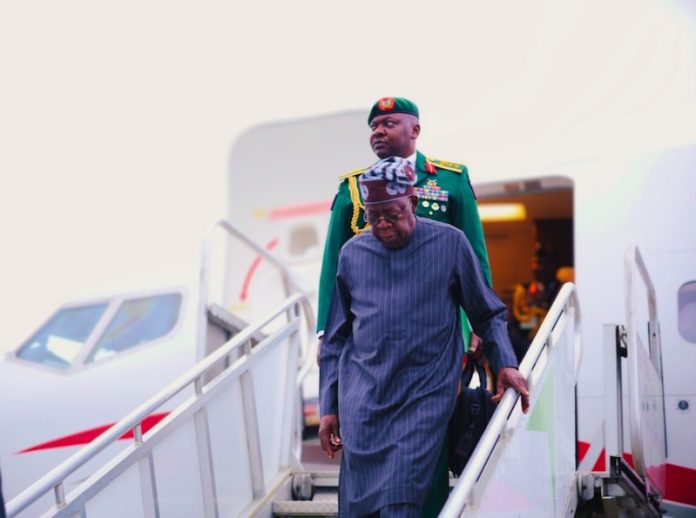
President Bola Tinubu arrived in Vieux Fort, Saint Lucia, on Saturday at 5.30 p.m. local time.

This was disclosed in a statement by presidential spokesperson Bayo Onanuga on Saturday night.

He said, upon Tinubu’s arrival at Hewanorra International Airport, he was accorded full military honours and received by the Governor-General of Saint Lucia, His Excellency Cyril Errol Melchiades Charles, and Prime Minister Philip J. Pierre.

Saint Lucia military parade for Tinubu

According to Onanuga, the visit marks the first leg of his two-nation trip to the Caribbean and South America.

Tinubu flanked by Saint Lucian at the airport

Tinubu will kick off the state visit on Sunday by paying courtesy calls on the Governor-General and Prime Minister Philip Pierre.

The President will address a special joint session of the Senate and the House of Assembly of Saint Lucia on Monday.

The event will take place at the William Jefferson Clinton Ballroom, Sandals Grande, Gros Islet.

“Guests include the Heads of Government of the Organisation of Eastern Caribbean States (OECS), senior Saint Lucian government officials, members of the diplomatic corps, the Nigerian community in Saint Lucia, and the Director-General of the OECS, Dr. Didacus Jules.

“President Tinubu will hold a high-level working luncheon with the Heads of Government of OECS after the joint session of the Parliament of Saint Lucia.

“Discussions will centre on deepening cooperation between Nigeria and the OECS, focusing on economic partnerships and cultural solidarity for shared prosperity.

“According to the President’s itinerary, he will visit the Sir Arthur Lewis Community College in Castries to strengthen educational ties and promote academic exchange.

“President Tinubu’s visit underscores Nigeria’s commitment to strengthening diplomatic and economic relations with Caribbean states, particularly within the African Union’s Sixth Region framework, which recognises the African diaspora as a vital partner in the continent’s development”, the statement partly reads.

After his engagements in Saint Lucia, the President will proceed to Brazil to participate in the 2025 BRICS Summit in Rio de Janeiro from July 6 to 7, 2025.

President Tinubu would be attending the BRICS summit at the invitation of President Luiz Inácio Lula da Silva of Brazil, based on Nigeria’s status as a ‘partner country’—a ‘membership category short of full membership.

The partner status is higher than that of a guest country, as has been the case in the past. South Africa, Egypt, and Ethiopia are African members of BRICS.

The 17th BRICS Summit will focus on “Strengthening Global South Cooperation for More Inclusive and Sustainable Governance

BREAKING: There’s no change—Presidency speaks on resignation of George Akume

0

The presidency has debunked claims that the Secretary to the Government of the Federation, George Akume, has resigned.

In a statement by a presidential spokesperson, Bayo Onanuga, on Saturday night, described the claim as untrue.

According to him, President Bola Ahmed Tinubu, who is currently in Saint Lucia, has not made any new appointments.

He stressed that there is no change in the status of Nigeria’s SGF, Akume.

“There has been no change in the status of His Excellency, Senator George Akume, as Secretary to the Government of the Federation.

“President Bola Ahmed Tinubu, currently in Saint Lucia, has not made any new appointments.

“The information circulating about Akume’s replacement is untrue. Agents of mischief fabricated it.

“The Presidency advises Nigerians to disregard the fake news,” the statement reads.

Also, when Nigerian Newssphere contacted the Special Adviser on Public Affairs to Akume, Terrence Kuanum said the claim is ‘fake news.’

The clarification comes amid rumours that Akume has resigned as SGF.


Aliko Dangote’s uncle, Amimu Dantata dies at 94

0

Popular Nigerian businessman Alhaji Aminu Alhassan Dantata has passed away at the age of 94.

He died in Abu Dhabi.

Uba Tanko Mijinyawa, the Deputy National Treasurer of the Nigerian Association of Chambers of Commerce, Industry, Mines and Agriculture (NACCIMA), disclosed the news of his death in a social media post.

He also announced that details of the late Dantata’s Muslim funeral prayer (Jana’iza) will be announced in due course.

His message read, “Indeed, we belong to Allah, and to Him we shall return. May Allah have mercy on our father and elder, Alhaji Aminu Alhassan Dantata. We pray for his forgiveness. The time of his funeral will be announced,” wrote as translated in English.

He is the grand-uncle of Aliko Dangote, Nigeria and Africa’s richest man.

Also Aminu Alhassan Dantata was the last surviving child of Alhassan Dantata, the great-grand father of Dangote.

Aliko Dangote’s uncle, Amimu Dantata
Alhaji Aminu Alhassan Dantata

Alhaji Dantata was the founder of Express Petroleum & Gas Company Ltd and a key figure in the establishment of Jaiz Bank, Nigeria’s first non-interest (Islamic) bank. His legacy spans decades of contributions to commerce, industry, and humanitarian causes.

NITDA announces initiative to retain ICT talent in Nigeria’s civil service

0

The National Information Technology Development Agency (NITDA) announced that it has introduced a Digital Competence Framework and Career Progression Model aimed at strengthening ICT capacity and retaining skilled professionals within Nigeria’s civil service.

NITDA’s Director General, Kashifu Inuwa, made this known in his statement during the maiden edition of the International Civil Service Conference organised by the Office of the Head of the Civil Service of the Federation in Abuja recently.

According to him, the move is part of broader efforts to make public service roles more attractive and professionally rewarding.

Representing the Director General of NITDA, Dr. Ahmed Tambawal, Acting Director of the Digital Literacy and Capacity Building Department, explained that the initiative—developed in collaboration with the Office of the Head of the Civil Service of the Federation—aims to tackle the challenge of stagnant roles and the underutilization of digital talent within government institutions.

“Highly skilled professionals are often stuck in roles that don’t reflect their expertise, while their counterparts in the private sector benefit from clear advancement paths and continuous training,” Inuwa explained.

The framework, already being implemented within NITDA, will be extended to other Ministries, Departments, and Agencies (MDAs). It provides structured career pathways and access to globally recognised certifications, enabling civil servants to grow professionally while contributing meaningfully to Nigeria’s digital transformation.

In addition, NITDA has launched a Digital Champions Programme in partnership with the Office of the Head of Service. The initiative identifies top digital talents across MDAs and equips them with specialised training to lead innovation within their respective organisations.

“These champions will drive digital change from within, promoting efficiency and fostering a culture of innovation across government,” the DG added.

The initiatives come at a time when the country is grappling with a mass exodus of skilled professionals—commonly referred to as the “Japa” trend—driven by the pursuit of better career opportunities abroad.

He noted that by creating a more dynamic and rewarding work environment for ICT professionals, NITDA aims to reverse this trend and build a competent, future-ready public service. “We are committed to developing a digital civil service that retains talent, encourages growth, and drives national development,” Inuwa stated.

On her part, the Head of the Civil Service of the Federation, Didi Esther Walson-Jack said it will not be business as usual for civil servants.

Other speakers at the session include PS Faruk Yabo Yusuf (lead speaker), Kevin Cunnington, and Wumi Oghoetuoma-Jolomi. The discussions were also centred around the rapidly evolving government landscape, driven by the imperative of digital transformation. This involves not only adopting new technologies but also fundamentally reimagining how governments operate, interact with citizens, and deliver services. Success hinges on developing key skills within the civil service, robustly assessing capabilities, and making strategic changes to leverage public data effectively for more responsive and personalised outcomes.

L-R the Moderator, Mrs Wumi Oghoetuoma-Jolomi,PS Faruk Yabo Yusuf (lead speaker), Dr Ahmed Tambuwal (Rep, DG NITDA) and Kevin Cunnington.

The theme of this conference is “Rejuvenate, Innovate & Accelerate!” at a session titled “Digital Transformation: Digital Skills for Civil Servants—Capacity Gaps and Future Readiness.”

Nigerian Newsphere reports that Nigeria has over 6,000 civil servants across the three tiers of government, according to a survey in 2021; however, there is no verified figure from the Civil Service of the Federation.

Similarly, data from the Nigerian Immigration Service showed that 3.6 million Nigerians emigrated within 2022 and 2023.

Sealed Without Trial? Illegality of FCTA’s Self-Help Property Crackdown: A Constitutional, Statutory, Diplomatic Assessment

0

Introduction: Why this debate matters in legal, diplomatic, and real estate circles across Abuja, a recurring concern continues to surface: the Federal Capital Territory Administration’s (FCTA’s) increasing resort to sealing properties, often without prior judicial authorization, based solely on public notices published in newspapers announcing the planned revocation of titles and subsequent enforcement actions for alleged non-payment of ground rent. What was once a marginal administrative practice has now evolved into a significant constitutional issue, with far-reaching implications for governance, the rule of law, and Nigeria’s international obligations.

At the heart of the controversy is a deceptively simple question: Can the FCTA, citing unpaid ground rent, seal off properties, including those earmarked for diplomatic use, without first going to court? It may seem like a technical point, but the implications go to the very foundation of the Nigeria’s legal system.

Let’s be clear: governments have the authority to enforce land-use laws and recover debts. But how they go about it is everything. When state agencies sidestep the courts and resort to self-help, they blur the line between lawful enforcement and executive overreach. And when that enforcement involves diplomatic missions, protected under international law, the stakes become global.

This article is a response to growing anxiety among property owners, diplomats, and even public officials who are unsure where lawful authority ends and unlawful aggression begins. It also examines, with clarity, what the law permits and prohibits regarding the sealing of properties over alleged ground rent defaults.

What This Article Aims to Do:

1. Clarify what powers the FCTA truly has, especially under the Land Use Act and other relevant statutes.

2. Affirm that due process is not a courtesy, it is a constitutional right, anchored in Section 36 of the 1999 Constitution and the bedrock of our legal tradition.

3. Expose the limits of government power, especially when it comes to diplomatic properties shielded under the Vienna Convention on Diplomatic Relations.

4. Offer practical alternatives that ensure compliance without compromising the rule of law or Nigeria’s international reputation.

5. Equip embassies, businesses, and private landowners with clear, lawful strategies for protecting their interests.

Legal Authority under the Land Use Act: 

What the Law Allows, and What It Doesn’t

The Land Use Act, Cap L5, LFN 2004, vests all land in a state (or in this case, the FCT) in the Governor or Minister, to be held in trust and administered for the use and benefit of all Nigerians. This includes the power to grant and revoke rights of occupancy.

Under Section 28(5)(a) of the Act:

“The Governor may revoke a right of occupancy… for a breach of any of the provisions which a certificate of occupancy is by section 10 deemed to contain.”

Section 10(b) of the Act provides:

“That the holder binds himself to pay to the Governor the rent fixed by the Governor and any rent which may be agreed or fixed on revision in accordance with the provisions of section 16 this Act.”

What does this mean? While the FCTA may revoke the right of occupancy for breach, such as non-payment of ground rent, such revocation must be preceded by proper notice and must not be enforced unilaterally. Again, there is no statutory provision authorizing the FCTA to seal or seize property outside court supervision. On the contrary, such actions may amount to trespass and executive lawlessness.

Due Process Is Not Optional — It Is Constitutional 

Section 36(1) — 1999 Constitution (As Amended) guarantees:

“In the determination of his civil rights and obligations… a person shall be entitled to a fair hearing within a reasonable time by a court or tribunal established by law.”

Thus, any punitive action, including sealing, must be preceded by notice, a right to be heard, and judicial determination. Thus, in the case of Union Bank of Nigeria Plc v. Ajabule & Anor, the Nigeria’s apex court (Supreme Court) unequivocally held that:

“Even where a right exists, it must be exercised within the boundaries of due process and not by resorting to self-help.”

Similarly, in the landmark case of Governor of Lagos State v. Ojukwu, the Supreme Court reiterated:

“The government, no matter how powerful, must not take the law into its own hands.”

The legal principle established by the above judicial authorities is – You cannot use unlawful means to enforce a lawful claim. Consequently, FCTA’s sealing of properties without a court order is inconsistent with this binding judicial precedent.

Role of the Federal Capital Territory Urban and Regional Planning Tribunal

Pursuant to the powers conferred by Section 86 of the Nigerian Urban and Regional Planning Act, Cap N138, Laws of the Federation of Nigeria 2004, the Federal Capital Territory Urban and Regional Planning Tribunal (Procedure) Rules were enacted in 2017 to operationalize the dispute resolution framework under the Act, specifically for the Federal Capital Territory (FCT). The tribunal, established as a quasi-judicial body, serves as the primary forum for resolving land use and development disputes, including proposed revocation of titles and the sealing of properties by the FCTA. By law, parties must first seek redress through this tribunal before the FCTA can lawfully seal any premises within the Federal Capital Territory (FCT). This requirement upholds due process and reinforces the rule of law by ensuring that property rights are not curtailed through unilateral administrative actions.

Diplomatic Property

Nigeria is a signatory the Vienna Convention on Diplomatic Relations (VCDR), 1961 and thus, is bound by its provisions. Article 22(1) of the VCDR provides:

“The premises of the mission shall be inviolable. The agents of the receiving State may not enter them, except with the consent of the head of the mission. “

Article 22(2) further provided thus: 

“The receiving State is under a special duty to take all appropriate steps to protect the premises of the mission against any intrusion or damage and to prevent any disturbance of the peace of the mission or impairment of its dignity.”

Additionally, Article 22(3) of the VCDR also provides:

“The premises of the mission, their furnishings and other property thereon and the means of transport of the mission shall be immune from search, requisition, attachment or execution.”

Therefore, the combine effect of the above provisions is that any sealing, entry, or coercive action against diplomatic missions is a direct breach of the VCDR and exposes Nigeria to:

International litigation at the ICJ or regional bodies, Diplomatic sanctions, or Reciprocal actions against Nigerian missions abroad.

Furthermore, In Ministry of Foreign Affairs v. Onwuka (2006) 7 NWLR (Pt. 980) 1, the Court of Appeal made it clear that foreign embassies and their staff are shielded from lawsuits or legal actions in Nigerian courts, provided the Minister of Foreign Affairs issues a certificate confirming their diplomatic immunity. The judgment not only reaffirms Nigeria’s commitment to international diplomatic norms but also underscores that, without a clear waiver of that immunity, foreign missions remain beyond the reach of local civil or criminal proceedings.

Best Practices: What the FCTA Must Do

Given the legal landscape, ThinkField Law recommends the following steps for lawful enforcement:

Notification via the Ministry of Foreign Affairs

All correspondence to foreign missions must go through the Ministry of Foreign Affairs, per established diplomatic practice and Executive Guidelines under Nigeria’s foreign policy framework.

Diplomatic Engagement

Disputes involving foreign missions or entities must be approached through diplomatic channels—such as bilateral negotiations, mediation, or, where appropriate, arbitration—in full recognition of their protected status under international law. This principle is reinforced by Article 22 of the Vienna Convention on Diplomatic Relations (VCDR), which prohibits not only the initiation of enforcement proceedings against diplomatic premises but also the execution of judgments against them. Thus, even where a domestic court issues a valid judgment, its enforcement must yield to the absolute inviolability accorded to diplomatic property.

Use of FCT Urban and Regional Planning Tribunal or Courts of Competent Jurisdiction

Before any revocation of title or sealing of property within the Federal Capital Territory, Abuja, the FCTA is legally bound to initiate proceedings before the FCT Urban and Regional Planning Tribunal—or, where appropriate, the FCT High Court. This procedural step is not a mere formality; it is a constitutional imperative that guarantees the right to fair hearing under Section 36 of the 1999 Constitution. Adhering to this process not only upholds the rule of law but also insulates administrative actions from being overturned on judicial review for procedural impropriety.

Transparent Reconciliation of Debt

In Bendel Insurance Co. Ltd. v. Edokpolor, the Court of Appeal held that “a disputed debt must be verified and adjudicated before enforcement.” Thus, all allegations of non-payment of ground rent must therefore be resolved through audit, reconciliation, and a right of reply between the FCTA and the affected property owner(s).

Recommendations for Affected Property Owners

For embassies, companies, or individuals whose properties are under threat, ThinkField Law recommends:

Immediate Legal Counsel

Engage land/property law experts with experience in FCTA-related matters. ThinkField Law has successfully advised in multiple enforcement disputes involving the FCT authorities.

Apply for Declaratory and Injunctive Reliefs

File a suit at the FCT High Court for:

Declarations that the sealing or proposed sealing was/is unlawful;

Interim and interlocutory injunctions restraining proposed or further actions;

Orders of mandamus compelling adherence to due process.

Lodge Diplomatic Protests (For Foreign Missions) at the Federal Ministry of Foreign Affairs

When a foreign mission in Nigeria believes its property rights have been violated—

whether through sealing, revocation threats, or other enforcement actions—the Head of Mission should promptly submit a formal Note Verbale to the Federal Ministry of Foreign Affairs. This step goes beyond diplomatic tradition; it activates official channels and ensures the issue receives the seriousness and intergovernmental coordination it requires. If the matter remains unresolved, the mission may notify its home government or escalate the issue to relevant international bodies. This process aligns with Articles 22 and 41 of the Vienna Convention on Diplomatic Relations (VCDR), which Nigeria, like all signatory states, is legally bound to uphold.

Demand for Reconciliation

Challenge ground rent claims by requesting itemized billing and submitting proof of payment, such as receipts or bank confirmations.

Final Word: Power Must Bow to Process

The law is neither silent nor ambiguous on this matter. Power, even when derived from statute, must operate within the boundaries of due process, constitutional order, and international respect.

Written by Emeka Ogenyi (LP), Lead Partner, ThinkField Law, can reached at: Info.thinkfieldlaw@gmail.com Meogenyi@gmail.com

FCT, Ground Rent Emeka Ogenyi


NIMC trains NYSC members for nationwide NIN ward enrolment

0

The National Identity Management Commission (NIMC) has announced a partnership with the Ministry of Youth Development and the National Youth Service Corps (NYSC) to commence training of selected NYSC members to drive National Identification Number (NIN) enrolment to all the wards in the Federation.

This was disclosed in a statement by the commission’s spokesperson, Kayode Adegoke, on Tuesday.

According to the statement, the initiative is part of President Bola Ahmed Tinubu’s Renewed Hope Agenda of enrolling and issuing the NIN to all Nigerians and legal residents within the shortest time possible.

NIMC has enrolled and issued the NIN to over 120M Nigerians and legal residents and, therefore, intends to cover hitherto unreachable areas through the Ward Enrolment initiative. The Corps members selected are currently undergoing intensive training in preparation for the kick-off of the ward enrolment.

Consequently, Nigerians, most especially children below the age of 16 years, are by this initiative encouraged to enrol for the NIN in their respective wards. This initiative aims to take NIN enrolment closer to the people. on

In her comment, Director General of NIMC, Abisoye Coker-Odusote, lauded the immeasurable support of President Tinubu towards the achievements of the NIMC mandate.

She also appreciated the commendable efforts of the Honourable Minister of Youth Development, Mr. Ayodele Olawande, and the DG, NYSC, Brigade-General Olakunle Oluseye Nafiu.


Jojobet GirişGrandpashabetgrandpashabetMadridbetcasibom güncel girişjojobetJojobet GirişjojobetcasibomholiganbetjojobetjojobetcasibomJojobetjojobetbetcio