Wednesday, July 1, 2026
Home Blog Page 247

AU research council, environmental society partner for greener Africa

0

The African Union-African Scientific Research and Innovation Council (AU-ASRIC) says it will collaborate with the Nigerian Environmental Society (NES) to create and promote safer environments in Africa.

The collaboration, under the aegis of the African Environmental Society (AES), would seek to address critical environmental challenges facing the continent.

The Executive Director of the African Union Scientific Technical Research Commission (AU-STRC), Engr. Dr. Ahmed Hamdy, said this on Monday in Abuja while addressing newsmen.

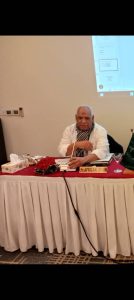
The Executive Director, African Union Scientific Technical Research Commission (AU-STRC), Engr. Dr. Ahmed Hamdy.

The News Agency of Nigeria (NAN) reports that AU-ASRIC is a specialised advisory institution under the AU-STRC.

He said Africa was faced with mounting environmental crises that ranged from desertification to pollution and urged a unified action against the challenges.

“The AES is envisioned as a powerful continental scientific body, uniting experts and agencies to tackle environmental issues.

“This initiative signifies a collective commitment to a sustainable future, where diverse actors work together to protect the environment, conserve natural resources, and build a healthier and more prosperous continent for all.

“The challenges are immense, but our crucial role will be to provide independent, reliable information and act as a strong advocate for environmental protection across Africa,” he said.

The AU-STRC chief said that AES would unite experts across the continent to tackle critical environmental challenges, protect the planet, and build Africa’s environmental future.


He emphasised that AES was a direct response to the urgent need for coordinated and effective strategies to mitigate the continent’s environmental vulnerabilities.

Hamdy said that 10 environmental societies from 10 different AU member states had committed to participate in the initiative, adding that it was strong support for the project.

“By uniting experts from diverse fields and across numerous African Union member states, the AES will ensure a comprehensive understanding of environmental challenges and their context-specific solutions,” he said.

He said the milestone underscored the recognition of the need for a unified continental approach to environmental management and conservation.

“This collaborative approach will lead to more effective, evidence-based policies that address the unique environmental vulnerabilities of different regions within Africa.

“This collective commitment signals a shared urgency to address Africa’s environmental challenges.

“The AES will act as a unified voice, advocating for stronger environmental regulations, increased investment in sustainable practices, and greater international cooperation,” Hamdy said.

It’s Global testament to Nigeria’s digital transformation- Minister Tijani on emerging as Vice Chair of ITU

0
Dr Tijani Minister of Communications in Nigeria

Nigeria’s Minister of Communications, Innovation, and Digital Economy, Bosun Tijani, said his emergence as Vice Chair of the International Telecommunications Union (ITU) Council, 2025, is a global testament of the country’s commitment to digital transformation and inclusive innovation as well as a remarkable milestone for Nigeria.

Tijani said this according to a recent statement by the deputy director of Communication at his Ministry, Eunice Akro.

The statement said the election took place in Geneva, Switzerland, against the backdrop of the ongoing ITU Conference.

In his acceptance speech, Dr. Bosun Tijani expressed delight, stating that “Nigeria remains committed in her resolve to support the collective mission of the ITU, particularly by prioritising its key areas such as the provision of resilient and sustainable digital infrastructures and timely access by all communities, especially the underserved, to meaningful connectivity,” amongst others. With this leadership position, Nigeria is poised in an enhanced capacity to shape the future of digital development on the African continent and beyond.

The minister lauded the ITU secretary general, Ms. Doreen Bogdan-Martin, the management team, and all member states for the trust placed in him, while pointing out that the world is presently in a defining moment, made by the accelerating pace of technological change and deep structural shifts in our societies.

Speaking further, the minister said, “Yet we are also uniquely privileged to witness the transformative power of digital technology, a force that allows us to be more introspective, inclusive, and informed as we shape the future.”


Dr. Tijani congratulated the ITU Chair, Ms. Cristiana Flutur of Romania, pledging to work closely with her to attain shared goals. He called on all to “make the ITU a beacon of inclusive innovation and trusted collaboration for today and future generations.”


The ITU Conference is currently in progress in Geneva, Switzerland.


The ITU, founded in 1865, is the oldest specialised United Nations (UN) agency responsible for information and communications technologies (ICTs) and is charged with the global mandate of connecting the world through innovative, inclusive, and sustainable digital solutions, facilitating connectivity in communication networks.


NCC to prosecute vandals of telecoms infrastructure in Nigeria

0
EVC NCC, Aminu Maida

The Nigerian Communications Commission (NCC) has stated its resolve to work with security agencies to arrest and prosecute vandals of Critical National Information Infrastructure (CNII) across Nigeria.

Aminu Maida, Executive Vice Chairman (EVC) and Chief Executive Officer (CEO) of NCC, stated this on Thursday at a media engagement in Abuja.

It would be recalled that President Bola Tinubu had signed the “Designation and Protection of Critical National Information Infrastructure Order, 2024,” which is aimed at protecting these critical systems from cyberattacks and other disruptions.

Maida, represented by Mrs. Nnena Ukoha, Deputy Director and Head, Corporate Communications Management, Public Affairs Department, said the Critical National Information Infrastructure (CNII) Act has provisions for prosecution, and the operationalization of CNII falls under the purview of the Office of the National Security Adviser (ONSA).

He warned that “anyone found liable for damaging or disrupting CNII will be prosecuted going forward.

“We are working with relevant agencies like the Nigeria Security and Civil Defence Corps, (NSCDC) to tackle these problems and prosecute offenders.”

Continuing, he said, “About two years ago, we noticed a situation where some of our key telecom operators were recording massive losses.

“Despite increasing revenues, they were struggling with heavy forex-related obligations that ate into their revenues. This led to poor quality of service.

He pointed out that with the recent tariff adjustment exercise, these operators are now back on the path to profitability.

He said, “As a result, they’re able to reinvest in their networks, which will lead to better quality of service and experience.

“We expect investments in the industry to increase significantly this year, more than what was seen in the last two years.

“The Nigerian telecoms industry has great promise, evident in its revenue growth and service delivery, despite the recent challenges.”

The Executive Vice Chairman of NCC underscored the importance of collaboration and information sharing between the NCC and other stakeholders to address challenges in the telecoms industry.

Commenting further on the indispensable role of telecoms infrastructure in national security, he said, “We all know that telecoms infrastructure plays a vital role in national security due to increasing cyber threats and vulnerabilities that can damage and disrupt communication infrastructure.

“Telecommunication services are crucial for ensuring national security, particularly for addressing security issues that require effective communication.

“Without effective telecommunication, achieving national security would be impossible.

“Telecommunication also plays a vital role in public welfare, contributing to the growth of a digital society.

“It provides an enabling environment for socialisation and access to services. Without a robust telecommunication infrastructure, the public cannot fully enjoy the services provided.

“Furthermore, a stable telecommunication infrastructure is essential for every sector of the economy.”

The CNII refers to essential computer systems, networks, and communication infrastructures whose disruption or destruction would have a significant negative impact on the nation’s economy, security, public health, or general safety.

Earlier, the commission promised to ensure improved quality of service in telecoms industry.

EU to spend €10.4m on sustainable energy in Nigeria’s healthcare

0

The European Union (EU) says it will spend €10.4 million on the Nigeria Solar for Health Project (NISHP), which aims to provide primary healthcare centres with reliable and sustainable solar energy solutions.

Inga Stephanowicz, Head of Section, Green & Digital Economy, EU, said this at the Project Developers Roundtable Workshop for NISHP, which was held in Abuja.

She said the project aimed at enhancing Nigeria’s healthcare sector by providing reliable energy to boost healthcare services and outcomes in Nigeria.

“This €10.4 million initiative, funded by the European Union, marks a milestone in the project’s implementation in Nigeria.

“ NISHP, an initiative funded by the EU, will provide 24-hour access to clean, efficient, and reliable energy to participating public healthcare facilities across the country.

“It aims to improve the country’s healthcare system by providing solar power to public health facilities in participating states,” she said.

According to her, by working together with the Nigerian government, private sector entities, and local communities, the EU is supporting Nigeria’s development goals and promoting a brighter future for its citizens.

She said the beauty of the project was its focus on sustainability, adding that it would provide an adequate solar power supply to 45 healthcare facilities in selected states.

“By collaborating with state government actors in a targeted electricity market and leveraging available counterpart funds, the project aims to electrify not only health centres but also SMEs, telecom towers, and others,” she said.

Nasiru Bello, Team Lead, NISHP, said by leveraging solar power, Nigeria could improve healthcare outcomes, increase access to electricity, and promote economic growth.

He said as the project progressed, it was crucial to monitor its impact and make adjustments as needed.

“ The NISHP is a step in the right direction towards a brighter, more sustainable future for Nigeria’s healthcare sector.

“ With continued support and effective implementation, this initiative can make a lasting difference in the lives of millions of Nigerians,” he said.


Bello said the NISHP highlighted the EU’s commitment to sustainable development and partnership with Nigeria and would serve as a model for other renewable energy projects in Africa.

He also said the project’s impact extended to healthcare as it would promote economic growth and community development.

This, he said, was by electrifying small and medium-sized enterprises and telecom towers near healthcare facilities.

Also speaking at the event, Tinyan Ogiehor, Stakeholders Engagement Expert, NISHP, said the project’s potential impact could also be felt in rural areas where access to electricity was limited.

“By leveraging solar power, Nigeria can reduce its reliance on fossil fuels, mitigate climate change, and promote sustainable energy solutions.

“ By providing reliable and sustainable solar energy solutions to primary healthcare centres, the project will enhance medical care, vaccine storage, and emergency services,” he said.

The News Agency of Nigeria (NAN) reports that the workshop brought together key stakeholders, including state government officials, private sector entities, and technology service providers.

The project has been inaugurated in Abia, Akwa-Ibom, Ogun, Plateau, and Enugu, with other states set to participate. It will run from 2024 to 2027.

NITDA announces first National Cybersecurity Conference in Abuja

0

The National Information Technology Development Agency, in collaboration with the Office of the National Security Advisor and QNA, has announced the inaugural National Cybersecurity Conference.

This announcement was disclosed in an inauguration press conference held at NITDA headquarters in Abuja on Monday, noting that the event is slated for July 9-10, 2025, with the theme ‘Building A Resilient Digital Future.’

Speaking at the event, the Managing Director of NITDA, Kashifu Inuwa, urged all critical stakeholders in the public and private sectors to be part of the epoch conference.

He explained that the conference is not merely to guard against cyber threats but also pivotal in building future cybersecurity in Nigeria and the African continent.

“The conference will serve as a launchpad for the new ideas, strategic initiatives, and sustainable partnerships aimed at transforming Nigeria’s cybersecurity landscape.”

He emphasised that the conference, which would be held annually, would help to mitigate against cyber threats and help to annexe the huge revenue and job opportunities potential in the sector.

On his part, Sa’ad Abubakar, National Cybersecurity Coordinator of ONSA, highlighted the significance of the conference to safeguarding the nation’s cyberspace.

“Cyber threats are evolving rapidly, and it is impacting the nation’s national security,” he stated.

Similarly, the managing director of QNA, Ankit Shukla, said he is excited to collaborate with NITDA and the Nigerian government to achieve the aim of the conference.

The NCSC is not just an event; it is a catalyst for innovation, collaboration, and capacity building across cyberspace.

Earlier, a representative of the Cyber Security Experts Association of Nigeria lauded the initiative and called for active participation by Nigerians.

The events come on the heels of a surge in cyberattacks in Nigeria.

Recall that the chairman of the Economics and Financial Crimes Commission, Ola Olukoyede, said the agency learned about six commercial banks that were recently hacked.


DG NIMC wins award on outstanding performance in public sector

0

The National Identity Management Commission’s Director-General and Chief Executive Officer, Engr. (Dr.) Abisoye Coker-Odusote, has been awarded the Outstanding Performance in Public Service Award at the African Iconic Women Recognition Awards 2025. This prestigious award recognises her exceptional leadership and dedication to transforming Nigeria’s digital identity landscape.

In a statement on Monday by NIMC’s head of media, Dr. Kayode Adegoke, award organisers lauded Engr. (Dr.) Coker-Odusote’s innovative and transformational leadership style, noting that her commitment to developing a robust and secure identity database has been instrumental in changing the scope of digital identity in Nigeria. Her visionary leadership has positioned NIMC as a frontline player in the identity sector in Africa.

Under Engr. (Dr.) Coker-Odusote’s astute leadership, NIMC has achieved remarkable milestones, including a significant increase in National Identification Number (NIN) enrolment, the provision of a reliable and secure world-class identity database, and the implementation of a 25/35% salary adjustment for staff. Other notable achievements include improved staff welfare, enhanced human capacity building, data harmonisation, and effective collaboration with relevant government agencies in utilising the NIN.

One of the key drivers of NIMC’s success has been Engr. (Dr.) Coker-Odusote’s 5-point agenda, which is aligned with President Bola Ahmed Tinubu’s Renewed Hope Mandate. This agenda has led to unprecedented growth in Nigeria’s digital identity sector, marking a new era in the country’s history.

The Commission urges the general public to leverage the benefits of NIN Authentication (NINAuth) for seamless verification services. NINAuth is a cutting-edge solution designed to enhance the timely and secure verification of NINs. By using NINAuth, individuals can protect their data from unauthorised use, decide when and how their data is shared, and enjoy seamless interactions with government agencies. The commission is committed to empowering individuals with control over their NIN data, ensuring a more secure and efficient identity management system.

By downloading and using NINAuth, Nigerians can experience the full benefits of a secure and efficient identity management system. We congratulate Engr. (Dr.) Abisoye Coker-Odusote on this well-deserved recognition and look forward to continued progress in Nigeria’s identity management sector.


NCC orders MTN, GLO other MNOs to alert customers on outage

0
NCC

The Nigerian Communications Commission (NCC) has issued a mandatory order to MTN Nigeria, Glo, and mobile network operators in Nigeria to inform customers of major service outages on their networks through media channels.

The Commission disclosed this in a statement by its acting spokesperson, Nnenna Ukoha, on Sunday.

According to the mandatory order, all Nigerian MNOs are to inform their customers of the cause(s) of the service interruption and the area(s) affected by the service interruption/outage, as well as the time that would be taken to restore service.

“Consumers must also be informed one week in advance where operators have planned service outages.

“Directive on Reportage of Major Network Outages by Mobile Network Operators (MNOs)” is part of the Commission’s drive to ensure timely resolution of outages, enhance quality of experience for telecom consumers, and keep consumers informed.

According to the directive, mobile network operators, internet service providers, and other operators that provide last-mile services will also provide proportional compensation, including extension of validity, as may be applicable and in line with the provisions of the Consumer Code of Practice Regulations, where any major network outage continues for more than 24 hours.

“It identifies three types of major outages to include: any network operational condition such as fibre cut due to construction/access issues/theft & vandalism and force majeure that impacts five percent or more of the affected operator’s subscriber base or five or more local government areas (LGAs); having an occasion of unplanned outage of, or complete isolation of network resources in 100 or more sites or five percent of the total number of sites (whichever is less) or one cluster that lasts for 30 minutes or more; and lastly, any form of outage that can degrade network quality in the top 10 states based on traffic volume as specified by the Commission from time to time.

“In furtherance of this, the Commission has further directed that all major outages are to be reported by operators through the Commission’s Major Outage Reporting Portal, which is accessible to the public through the Commission’s website, www.ncc.gov.ng. The portal additionally discloses the identity of the culprit responsible for the disruptio”n.

Reacting to the development of the directive and the Major Outage Reporting Portal, the Director of Technical Standards and Network Integrity, Engr. Edoyemi Ogor, stated that “the Commission has trialled the reporting process and portal with operators for some months now before issuing the directive.

“By providing consumers and stakeholders in the telecommunications industry with timely and transparent information on network outages, we are entrenching a culture of accountability and transparency. This approach also ensures that culprits are held responsible for sabotage to telecommunications infrastructure.

“This also aligns with our broader commitment to the effective implementation of the Executive Order signed by President Bola Ahmed Tinubu, which designates telecommunications infrastructure as Critical National Information Infrastructure (CNII). It reinforces the need to safeguard these assets, given their centrality to national security, economic stability, and the everyday lives of Nigerians,” Ogor said.


First Bank backs Nigeria’s raw materials development

0
The DG, IFC, Mr Abiodun Famuyiwa, Head, SME Banking and the DG, Raw Materials Research Council

First Bank Nigeria Plc says it is committed to supporting the development of sustainable financial models to drive the development of raw materials in Africa.

The Managing Director/CEO of the bank, Mr. Olusegun Alebiosu, said this at the ongoing Africa Raw Material Summit in Abuja organised by the Raw Material Research and Development Council (RMRDC).

The News Agency of Nigeria (NAN) reports that the theme of the summit is “Shaping the future of Africa’s resources landscape.”

Represented at the event by Mr. Abiodun Famuyiwa, the Head of Small and Medium Enterprises (SME) Banking, Alebiosu said that the summit was a rallying point for forward-looking partnerships.

He said the bank was ready to direct funds into processing infrastructure, industrial parks, and green energy corridors linked to our raw materials.

“We are committed to building not just a resource-rich Africa but a resource-empowered Africa.

“We are committed to an Africa that is environmentally responsible, economically competitive, and strategically united,” he said.

He said the bank, being one of the continent’s premier financial institutions, was committed to building Africa’s industrial future.

Alebiosu also said the bank would also support policies, businesses, and innovations that would move the continent forward in the value chain of its natural resources.

He congratulated the organiser of the summit, particularly RMRDC, for granting the bank the opportunity to contribute to the dialogue of adding value to the continent’s natural resources before exporting them.

“It captures the urgency of redefining our approach to raw materials, not as mere commodities for export but as strategic assets for driving Africa’s industrial revolution, economic diversification, and sustainable development.

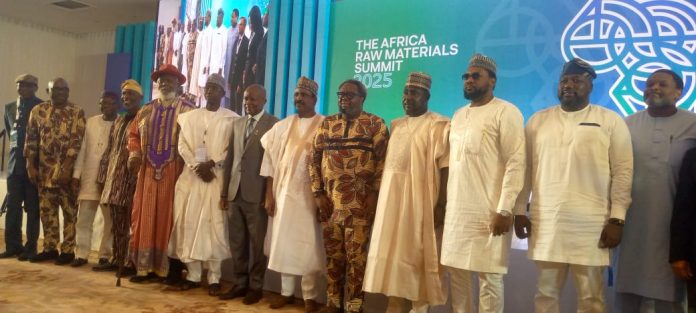
An array of Distinguished Dignitaries flanking the Min of State for Industry - Senator John Owan Enoh

“At First Bank, we believe that the future of Africa’s resource landscape must be built on value addition, inclusive financing, and green industrialisation,” he said. (NAN)

FG backs RMRDC’s initiatives to boost industrialisation

0

By Tolu Aiyegbusi

DG RMRDC, Prof. Nnanyelugo Ike -Muonso flanked by dignitaries at the African raw materials summit in Abuja. 

The Federal Government has shown support for the Raw Materials Research and Development Council (RMRDC) proposed legislation, which seeks to mandate 30 per cent local processing of raw materials before export.

The Senate President, Godswill Akpabio, in his address at the African Raw materials summit on Tuesday in Abuja, described the proposed bill currently before the National Assembly as a transformative step towards securing Nigeria’s economic future.

The senate president, represented by Sen. Aminu Abass, Chairman, Senate Committee’ on Science and Technology, lamented the country’s challenge of exporting raw materials in their crude form while foreign industries reap the benefits of processing.

He said, “The bill currently before the National Assembly is a significant step towards strengthening domestic production and in line with the FG’s Renewed Hope Agenda.

“ It is our collective responsibility to choose the path that will unleash the full potential of Nigeria and secure a brighter future for generations to come.”

According to Akpabio, the extractive model of exporting in raw form yet import with added value must now shift to a new paradigm rooted in local processing, regional integration, and sovereign economic vision.

He added, “ In the Nigerian Senate, we have resolved to be proactive in addressing this structural imbalance.

“ It is in this spirit that I reaffirm our full legislative backing for the 30% Minimum Value-Addition Bill, currently under consideration.”

The senate president said that the bill mandates that no raw material of Nigerian origin shall be exported without undergoing a minimum of 30 per cent local value addition.

“ We recognise that legislation alone is not enough. Institutions must be empowered. No government can do this alone.

“ Our task is to empower African entrepreneurs, SMEs, cooperatives, and young innovators who will turn mineral wealth into exportable machinery, agro-resources into packaged goods, and research into revenue.

“ We must also actively engage our diaspora—Africa’s sixth region—who bring with them not only remittances, but technical knowledge, financing models, and global market access,” Akpabio said.

He commended RMRDC for its strategic leadership in research, industrial innovation, and national resource mapping, a model of possibilities when research meets industrial application.

Akpabio also expressed hope that this model would be replicated across African nations, with regional centres of excellence established to share data, technologies, and best practices in raw material development.

“ In the Senate, we are already aligning our legislative priorities to ensure environmental sustainability, fair trade, and industrial growth.

“We are drafting laws to support climate-smart mining, regenerative manufacturing,”Akpabio said.

He stated that as legislators, they were committed to ensuring that Africa fully leverages the African Continental Free Trade Area (AfCFTA) to foster intra-African processing, technology transfer, and market expansion.

Also peaking, the Director-General of RMRDC, Prof. Nnanyelugo Ike-Muonso, urged Nigerians to take control of their economic destiny.

Ike-Muonso said through the bill, the council aimed to stem the tide of capital flight caused by unprocessed exports, stimulate local processing industries, and create sustainable jobs across multiple sectors.

According to him, the act’s requirement for a 30 per cent value addition to raw material exports would significantly boost investment opportunities in the country, enhance our competitiveness in global markets, and build a strong, self-reliant African industrial base.

“Africa is abundantly endowed with over 30 percent of the world’s strategic raw materials—ranging from agricultural produce to critical minerals such as lithium, cobalt, graphite, and rare earth elements,” the director-general said.

He said,”The country stands at a pivotal moment where the decisions made today will shape its future,” lamenting that the nation’s vast natural resources have long been exploited without translating into real economic gains for its people.

The Minister of Innovation, Science and Technology, Uche Nnaji, described the summit as a continental call to action and stood as a defining moment Africa.

“For too long, we have exported raw potential and imported dependency, this is a call to industrialise, add value, and create prosperity on African soil.

“ Value addition is not optional, it is essential. It is the engine of youth empowerment, SME growth, and economic sovereignty.

“ This is how Africa moves from extraction to transformation—from potential to prosperity,’’ he said.

Nnaji affirmed the ministry’s support for initiatives like Nigeria’s 30 per cent minimum value-addition policy and was deploying digital tools, traceability infrastructure, and research-to-industry pathways to strengthen intra-African trade under AfCFTA.

The News Agency of Nigeria (NAN) reports that the theme of the summit was: ‘Shaping the Future of Africa’s Resource Landscape’.

It had high-powered delegates from across the African continent such as Ghana and South Africa, among others.

The participants also included high-ranking government officials from various Ministries, Departments, and Agencies, financial institutions and corporate partners. (NAN) (www.nannews.ng)


Ekpa, Nnamdi Kanu: USB exposes DSS operation to foil Biafra Independence

0

The United States of Biafra said it has uncovered Department of State Security Services covert operation, named ‘doppelgangers’ to foil the independence of Biafra.

The Deputy Prime Minister of USB disclosed this in a statement on her official X account on Tuesday.

According to her, the DSS is reportedly behind the persecutive attacks against Biafrans and their activists.

Orabueze noted that the security operatives of the Nigerian government have secretly and forcefully taken over Biafra Radio to spew narratives against Biafra agitation.

“The Nigerian state security services, which is behind the persecutions, summary arrests, and executions of Biafrans both in the homeland and abroad and the unlawful detention of Mazi Nnamdi Kanu and Mazi Simon Ekpa, has been exposed as the puppeteer behind a captive Radio Biafra and IPOB impersonators or “doppelgangers.”

“Passing off is a legal concept in which a party is misrepresenting goods or services as being the goods and services of another. This is exactly what DSS has done with the counterfeit IPOB and Radio Biafra. DSS has created false personas and taken over dormant websites to spew disinformation about Biafra and its leaders. While Biafrans will not be surprised by the tricks and deceits of the DSS, much of the world remains ignorant of the Biafran liberation struggle and evil doings of the DSS.

“Not content with the murder and jailing of tens of thousands of innocent Biafrans, DSS has taken advantage of the false arrests of Mazi Nnamdi Kanu and Mazi Simon Ekpa to take over several dormant organisations in order to manufacture dangerous evidence and create false news.

“One tentacle of Operation Doppelganger is the DSS hijacking of Kanu’s Radio Biafra and the creation of the false IPOB persona know as Comrade Emma Powerful. Radio Biafra is incorporated in England and is dormant, meaning they are not conducting business:

“Radio Biafra and the false persona Emma Powerful recently denounced affiliates of United States of Biafra as murderers and agents of Nigeria including Mazi Simon Ekpa who sits in a solitary confinement cell in Finland for the “crime” of supporting Mazi Nnamdi Kanu and Biafra. Only DSS and its twisted agenda could develop such a plot.

“The United States of Biafra has instructed its legal counsel to immediately begin legal proceedings against Radio Biafra and Emma Powerful, public notice of which is attached. The legal prosecution of Emma Powerful, the captive IPOB, and false Radio Biafra is but the start and serves as a warning to DSS that USB will leave no stone unturned in exposing Operation Doppelganger affiliates,” the statement by Orabueze stated.

Recall that Ekpa and Kanu have been under the custody of the Finnish government and Nigerian government since November 2024 and June 2021, respectively.

Jojobet GirişGrandpashabetgrandpashabetMadridbetcasibom güncel girişjojobetJojobet GirişjojobetcasibomholiganbetjojobetjojobetcasibomJojobetjojobetbetcio