advertise with us
Home Blog Page 12

Drug trafficking: Tinubu faces fresh pressure as Atiku’s US lobbying firm intensifies records release push

0
President Tinbu

President Bola Ahmed Tinubu is facing fresh pressure over allegations of drug trafficking as a United States-based lobbying firm linked to former Vice President and African Democratic Congress (ADC) presidential candidate, Atiku Abubakar, vowed to intensify efforts to secure the release of records concerning the allegations.

Von Batten-Montague-York, L.C., which was reportedly hired by Atiku for $2.1 million to boost his reputation and counter Tinubu ahead of the 2027 presidential election, made the commitment in a statement posted on X on Tuesday.

The firm said the administration of former US President Joe Biden’s Department of Justice (DOJ) had fought the release of Freedom of Information Act (FOIA) records concerning allegations involving Tinubu.

It, however, said the DOJ under President Donald Trump would not protect anyone allegedly linked to drug trafficking.

According to the firm, the records relate to allegations that Tinubu was involved in heroin trafficking from Nigeria through Illinois to Indiana.

Von Batten-Montague-York also accused the Biden administration of focusing on Trump while resisting the release of records concerning Tinubu.

The firm said it appreciated Trump, US Attorney Jeanine Pirro, members of the Trump administration and Congress for refusing to follow what it described as the previous administration’s approach to the FOIA records.

“Unlike President Joe Biden’s DOJ, which fought the release of FOIA records concerning drug-trafficking allegations involving Nigerian President Bola Tinubu, the DOJ under President Donald Trump will never protect an alleged drug trafficker linked to the smuggling of heroin from Nigeria through Illinois to Indiana,” the firm said.

Nigerian Newssphere recalls that United States District Judge Beryl Howell on Tuesday gave Trump-appointed US Attorney Jeanine Pirro four additional days to release the drug-trafficking records concerning Tinubu.

However, Tinubu has joined the U.S. Department of Justice’s request for a 10-day extension to respond to a motion seeking the

The development followed a legal battle over the release of the records, with the documents attracting renewed attention ahead of Nigeria’s 2027 presidential election.

Atiku, who is seeking the ADC presidential ticket for the 2027 election, had engaged Von Batten-Montague-York in a reported $2.1 million lobbying arrangement aimed at improving his public image in the United States and countering Tinubu’s political influence.

The renewed push for the release of the records could therefore intensify political pressure on Tinubu as opposition figures and their allies continue to focus on allegations surrounding his past.

Tinubu has consistently denied wrongdoing, while the allegations remain politically contentious. The release of any US records would provide further details on what the documents contain and whether they substantiate the allegations.

Tinubu secured his re-election ticket in the ruling All Progressives Congress (APC) to battle Atiku Abubakar, Peter Obi of the Nigeria Democratic Congress (NDC), and other presidential candidates on January 16, 2027.

According to the Independent National Electoral Commission (INEC) timetable, political campaigns are expected to begin on Wednesday, August 19, 2026.

See the full names of the 2027 presidential candidates as confirmed by INEC:

  • Bola Ahmed Tinubu (APC)

  • Atiku Abubakar (ADC)

  • Peter Obi (NDC)

  • Sandy Ojang Onor (PDP)

  • Seyi Makinde (APM)

  • Omoyele Sowore (AAC)

  • Donald Duke (PRP)

  • Adewole Adebayo Ebenezer (SDP)

  • Suleiman Mohammed Dikwa (NNPP)

  • Anita Zugwai Chukwu (YPP)

  • Esther Iken Okereke (NRM)

  • Ada Elizabeth Okwori (NDP)

  • Aliyu Abbas-Bin (ADP)

  • Sunday Chibuzor Okereke (LP)

  • Daniel Nwanyanwu (ZLP)

  • Samuel Memeh (DLA)

  • Adekunle Rufai Omoaje (AA)

  • Sunday Adenuga (BOOT Party)

  • Kabiru Yusuf (APP).

Bola Ahmed Tinubu (APC)Atiku Abubakar (ADC)Peter Obi (NDC)Sandy Ojang Onor (PDP)Seyi Makinde (APM)Omoyele Sowore (AAC)Donald Duke (PRP)Adewole Adebayo Ebenezer (SDP)Suleiman Mohammed Dikwa (NNPP)Anita Zugwai Chukwu (YPP)Esther Iken Okereke (NRM)Ada Elizabeth Okwori (NDP)Aliyu Abbas-Bin (ADP)Sunday Chibuzor Okereke (LP)Daniel Nwanyanwu (ZLP)Samuel Memeh (DLA)Adekunle Rufai Omoaje (AA)Sunday Adenuga (BOOT Party)Kabiru Yusuf (APP)

APC panicking as US judge issues final ultimatum to Pirro over release of Tinubu Drug Records

0
President Tinbu

The ruling All Progressives Congress and presidency panicking as a United States District Judge, Beryl Howell, has granted Donald Trump-appointed US Attorney Jeanine Pirro an additional four days to release records relating to alleged drug-trafficking activities involving Nigeria’s President, Bola Tinubu.

The development was disclosed by Dr Von Batten-Montague-York in a post on X.

According to Von Batten, Judge Howell noted that the case had been pending for more than three years.


Pirro had reportedly requested an additional 10 days to comply with an earlier order concerning records held by the US Department of Justice (DOJ), Federal Bureau of Investigation (FBI) and Drug Enforcement Administration (DEA).


However, Judge Howell granted only four additional days, setting August 21, 2026, as the deadline for compliance.


Von Batten described the development as a renewed effort by Pirro and the DOJ to release the records, insisting that the documents should now be made public.


“We deeply appreciate US Attorney Pirro and the DOJ’s renewed motivation to release these documents, and we agree with Judge Howell. This case has been pending for three years. The time to release the Tinubu drug-trafficking files is now,” he wrote.


He argued that the United States’ strategic interests with Nigeria should not prevent the release of the records.


“As President Trump has indicated, our shared interests with Nigeria do not mean supporting an alleged drug trafficker,” he added.


The allegations contained in the records have not been established as fact against President Tinubu, and any release of the documents would need to be considered in the context of the court proceedings and the evidence contained in them.

BREAKING: Flooding: Wike begins massive demolition in Abuja[Video]

0
Wike Minister of FCT

Demolition operations have commenced in Maitama, Abuja, following the directive of the Minister of the Federal Capital Territory, Nyesom Wike, to remove buildings obstructing waterways and drainage channels across the FCT.


The demolition follows Wike’s inspection of areas affected by the flooding that occurred in the nation’s capital on Sunday.


During the inspection, the minister ordered the removal of properties allegedly built on or obstructing water channels, warning that the exercise would extend to other affected areas of Abuja.


Wike said all structures obstructing waterways and drainage channels linked to the recent flooding in Maitama and other parts of the FCT would be demolished before Saturday.


“We have seen where people block channels where water should pass. They did that believing that nothing will happen.


“I have told people that because nothing happened yesterday does not mean it won’t happen today. That it did not happen today does not mean it won’t happen tomorrow.


“Now, something will happen. I’m going to bring those houses down. Every house on the water channel will go down. From now till Saturday, we will bring them down,” he said.


The ongoing demolition is part of the FCT Administration’s response to the recent flooding and its efforts to clear blocked waterways and drainage channels across Abuja.


Watch video of the ongoing demolition.

Nigerian Govt unveils National Digital Cloud Policy 

0
Dr Tijani Minister of Communications in Nigeria

The Federal Government of Nigeria, through the Federal Ministry of Communications, Innovation and Digital Economy, has unveiled the National Digital Cloud Policy, establishing a comprehensive national framework for the growth, governance and internationalisation of Nigeria’s cloud computing and data infrastructure ecosystem.

In a statement by the Minister of Communications, Innovation and Digital Economy, Dr ‘Bosun Tijani, on Monday, the ministry said the policy represents a major component of the Federal Government’s broader digital economy agenda.

According to the statement, the policy provides a coordinated framework to attract investment in cloud and data centre infrastructure, position Nigeria as a regional digital services and hosting hub, modernise government service delivery, strengthen indigenous digital capabilities and establish proportionate safeguards for government and regulated data.

At its core, the National Digital Cloud Policy seeks to translate Nigeria’s significant domestic market, expanding broadband infrastructure, international connectivity and growing technology talent base into increased investment, local infrastructure capacity, job creation and digital service exports.

The policy establishes four overarching priorities:

Investment and market development: Creating a predictable and competitive environment for domestic and international investment in data centres, cloud infrastructure, connectivity and artificial intelligence computing capacity.

Regional digital services exports: Positioning Nigeria as a hosting, processing and interconnection hub for West Africa and the wider sub-Saharan African market.

Government cloud transformation: Implementing a strengthened Cloud First approach across Federal Ministries, Departments and Agencies (MDAs), supported by whole-of-government aggregation, coordinated procurement and shared digital infrastructure.

Digital sovereignty and security: Establishing clear, proportionate and risk-based requirements for the protection, residency and control of defined categories of government and regulated data.

The policy deliberately maintains an open, competitive and multi-provider cloud market, recognising that Nigeria’s digital economy will benefit from the participation of both domestic and international providers.

It therefore does not impose general data localisation requirements on commercial data. Sovereignty requirements are narrowly applied to defined categories of government and regulated data where national control is necessary.

A central feature of the policy is the use of the government’s collective purchasing power to accelerate domestic infrastructure investment.

Under the whole-of-government aggregation framework, the government will aggregate demand for cloud capacity from multiple registered providers and provide shared government cloud services.

The approach is designed to reduce duplicated expenditure, secure better commercial terms for the government and create predictable anchor demand capable of supporting long-term private investment in Nigerian digital infrastructure.

The policy will also establish a National Digital Marketplace to support coordinated and transparent procurement of cloud and digital infrastructure services, alongside dedicated cloud budget arrangements and an anchor-capacity mechanism intended to improve predictability in government demand.

To stimulate investment, the policy provides for a coordinated package of fiscal, regulatory, commercial and investment-facilitation measures for qualifying cloud and data infrastructure projects.

These include appropriate fiscal treatment for qualifying infrastructure and supporting equipment, coordinated regulatory facilitation, measures to address energy constraints, support for capital mobility and export earnings, as well as structured technology-transfer and capability-development obligations for investors benefiting from government incentives.

The government will also strengthen Nigeria’s position as a regional digital services exporter by supporting cross-border data flows, regional interconnection, international standards alignment, export promotion and mutual recognition arrangements.

The objective is to enable cloud and data services delivered from infrastructure located in Nigeria to increasingly serve customers across ECOWAS and the wider African market.

The Minister of Communications, Innovation and Digital Economy, Dr ‘Bosun Tijani, said cloud and data infrastructure had become foundational economic infrastructure for the digital age, underpinning artificial intelligence, financial services, digital government, healthcare, education, commerce and the next generation of technology-enabled services.

The minister stated: “Nigeria must move from being primarily a consumer of global cloud infrastructure to becoming a competitive location for the infrastructure, investment, skills and digital services that will define the next phase of the global digital economy.

“Our approach is deliberately open and investment-oriented. We want Nigerian and international providers to invest, build capacity, develop talent and serve both the Nigerian market and the wider African continent from Nigeria. At the same time, Government has a responsibility to ensure that its most sensitive digital assets are governed and secured in a manner consistent with our national interests.

“The National Digital Cloud Policy therefore provides a balanced framework — one that promotes investment and competition, strengthens indigenous capability, modernises Government and applies sovereignty requirements only where they are genuinely necessary.”

The policy establishes clearly delineated institutional responsibilities. The National Information Technology Development Agency (NITDA) will provide regulatory oversight, standards and assurance; Galaxy Backbone Limited (GBB) will lead operational delivery, shared infrastructure and aggregation; while the Bureau of Public Procurement (BPP) will ensure alignment with public procurement requirements.

This separation of responsibilities is intended to provide regulatory certainty and avoid conflicts between regulatory, operational and procurement functions.

A Sovereign Government Cloud Governance Committee, chaired by the minister responsible for Communications, Innovation and Digital Economy, will provide strategic oversight and whole-of-government coordination for implementation of the sovereignty framework.

Implementation will proceed through a phased 24-month roadmap.

The first six months will focus on policy activation, baseline assessments, implementation directives, institutional arrangements and investment facilitation.

Between six and 12 months, the government will operationalise the National Digital Marketplace, commence priority MDA migrations, onboard registered providers and begin regional market-development activities.

The subsequent 12 months will focus on scaling government migration, expanding capacity, onboarding participating states, strengthening regional interconnection and accelerating digital service exports.

The policy establishes measurable performance indicators for implementation, including targets for private investment committed to Nigerian cloud and data infrastructure, installed compliant hosting capacity, regional capacity contracted from Nigeria, digital service export earnings, government migration, cost savings and skills development.

The Federal Government’s initial ambition is to mobilise US$250 million in private investment within the first 12 months, rising to US$750 million within 24 months, alongside progressive increases in compliant hosting capacity and the development of Nigeria’s regional cloud export market.

The National Digital Cloud Policy complements ongoing Federal Government investments in digital infrastructure and human capital, including Project BRIDGE, which is designed to deploy at least 90,000 kilometres of additional fibre-optic infrastructure, and the 3 Million Technical Talent (3MTT) Programme, which is developing the technical workforce required to support cloud computing, artificial intelligence, cybersecurity, software engineering and other emerging technologies.

Through the policy, the Federal Government intends to create an integrated environment in which connectivity, cloud infrastructure, digital talent, investment policy and government demand reinforce one another to accelerate Nigeria’s digital transformation.

The Federal Ministry of Communications, Innovation and Digital Economy remains committed to working with public institutions, state governments, domestic and international cloud providers, data centre operators, investors, technology companies, academia and other stakeholders to implement the policy and establish Nigeria as a secure, competitive and globally connected digital infrastructure hub.

Osun 2026: How IReV reshaping election transparency ahead of 2027

0

By Moses Olili

There are some elections that produce a winner, and there are elections that produce a conversation. The Osun governorship election of August 15 has done both.

While the re-election of Governor Ademola Adeleke will understandably dominate the immediate headlines, perhaps the more consequential story lies elsewhere: in the way the election results became increasingly visible to the public and what that could mean for Nigeria’s electoral democracy ahead of the January 16 2027 general elections.

For years, one of the most difficult periods of a Nigerian election has been the interval between the close of voting and the formal declaration of results. It is a period often characterised by uncertainty, competing claims, unofficial figures and a flood of information that can be difficult for voters to verify.

Osun offered a glimpse of a different possibility.

Through the Independent National Electoral Commission’s Result Viewing Portal, IReV, polling-unit results were progressively made available, allowing citizens, political parties, journalists and election observers to follow the emergence of the results rather than depend entirely on competing political narratives.

The significance of this became particularly apparent when a news medium was able to call the direction of the election before INEC formally announced the winner.

That was not a replacement for INEC’s constitutional responsibility. Only the commission can officially declare the winner of an election. Rather, it was a demonstration of what becomes possible when primary election results are sufficiently accessible for independent scrutiny.

And that may be the most important lesson Osun offers Nigeria as the country approaches 2027.

From Waiting for Results to Watching Them Emerge

INEC has, over the years, invested considerably in improving the management and transparency of election results. IReV is perhaps the most visible expression of that effort.

The principle behind the platform is straightforward: once voting has ended and results are recorded at polling units, members of the public should be able to view the result sheets uploaded to the portal.

INEC itself states that the public can monitor polling-unit results in real time on Election Day as results are uploaded.

That seemingly simple change has significant implications.

Previously, Nigerians often had to wait for the formal collation process before having a comprehensive picture of an election. Now, the possibility exists for citizens and independent observers to follow the figures much closer to their source.

In Osun, that difference was particularly evident.

The commission’s IReV platform provided access to thousands of polling-unit results as the election progressed. The official portal continues to provide polling-unit-level information from the election, allowing the public to examine the results beyond the headline figures.


This creates a new layer of accountability.


A political party can compare the results with the records of its agents. Civil society organisations can examine patterns. Journalists can analyse emerging figures. And voters can look beyond claims made by political actors and engage with the underlying results themselves.

The significance of IReV, therefore, is not merely technological.

It is democratic.

The Media’s Early Call Is the Real Story

Perhaps the most striking development from Osun was the ability of a news medium to call the direction of the election before INEC’s formal declaration.


That development deserves to be understood properly.


It does not mean that the media has acquired the authority to declare election winners. It has not. Nor should media projections ever be confused with official results.


What it does demonstrate is that the information environment around Nigerian elections is changing.


When enough polling-unit results are publicly accessible, a media organisation with the necessary expertise can analyse the emerging figures, compare the results across local government areas and determine whether the remaining outstanding results are capable of changing the trajectory of the election.


That was considerably more difficult when election results were largely inaccessible to the wider public until the completion of formal collation.


The implication is profound.


INEC’s transparency has made independent scrutiny possible at a stage of the election when Nigerians were previously largely dependent on political actors for information.

The media is not replacing the electoral commission.

It is interrogating information produced by the electoral process.

That is precisely what a healthy democratic information ecosystem should encourage.

But Transparency Must Not Be Confused with Perfection

There is, however, a danger in celebrating technological progress without acknowledging the shortcomings that remain.

Osun was not a perfect election.

There were reports of technical and logistical challenges, while concerns were also raised over vote-buying, intimidation and other electoral irregularities. Those issues matter and should be investigated where appropriate.

INEC should therefore see Osun not as the conclusion of its electoral reforms, but as another stage in their development.

The commission must continue improving the reliability of BVAS, strengthen its logistics and ensure that polling-unit results are uploaded promptly and accurately.

Most importantly, the credibility of IReV must be protected.

A system designed to increase confidence can only fulfil that purpose if citizens believe that the information appearing on it accurately reflects what happened at the polling unit.

That means transparency must be accompanied by accuracy, consistency and accountability.

What Osun Means for 2027

This is where the significance of Osun extends beyond the state.

The 2027 general elections will place an extraordinary burden on Nigeria’s electoral infrastructure. There will be more polling units, more candidates, more results and considerably higher political stakes.

If IReV worked as an important transparency mechanism in Osun, the question now is whether the same level of accessibility and reliability can be maintained on a much larger scale.

The answer will matter enormously.

The credibility of the 2027 elections will not depend only on who wins. It will also depend on whether voters and political parties believe they were able to see enough of the process to understand and scrutinise the outcome.

Osun has therefore given INEC a valuable rehearsal.

The commission now knows what worked.

It also knows what needs improvement.

The objective should be to ensure that by 2027, the public does not merely receive election results—it can follow the journey of those results from the polling unit to the final declaration.

And Then There Is the Opposition

The other significant development emerging from Osun is the mood among opposition figures.

The response to the result has contained a noticeable element of optimism, with opposition politicians congratulating the eventual winner and urging Nigerians and political forces to draw lessons from the election ahead of 2027.

For opposition movements, that psychological dimension matters.

Political parties cannot sustain serious electoral competition if their supporters become convinced that elections are unwinnable.

They need to believe that votes can translate into political power.

Osun appears to have strengthened that belief.

The election has demonstrated that an incumbent can win under a different political platform, that a major political party can lose a closely contested governorship race, and that an election can produce an outcome that defies the expectations of political observers.

That does not automatically make Osun a predictor of 2027.

Nigeria’s political landscape is far more complicated, and the dynamics of a governorship election cannot simply be transferred to a presidential contest.

But the psychological effect should not be underestimated.

For opposition parties, Osun offers a reason to compete harder.

The challenge now is to convert that optimism into organisation.

They will need credible candidates, stronger grassroots structures, effective voter mobilisation and properly trained agents capable of following the vote from the polling unit through collation.

Optimism may create momentum.

Organisation will determine whether that momentum becomes political power.

A New Standard for Election Reporting

There is also an important lesson for the Nigerian media.

The early call in Osun demonstrates the possibilities created by access to real-time election data. But with that possibility comes responsibility.

Election projections must be based on verifiable results and a clear methodology. They must be distinguished from official declarations, and media organisations must be prepared to explain how they reached their conclusions.

The credibility of election reporting depends on getting that distinction right.

When properly handled, however, independent media analysis can actually strengthen INEC.

The more journalists, civil society groups and citizens scrutinise publicly available results, the greater the pressure on all electoral actors to ensure that those results are accurate.

That is not an attack on the electoral commission.

It is accountability.

The Real Test Begins Now

Osun has not solved Nigeria’s electoral problems.

Vote-buying remains a concern. Technical failures remain possible. Political intimidation remains a threat. Logistics can still undermine the voting experience.

But democracy does not improve only through perfect elections.

It improves when institutions learn, technology creates greater transparency and citizens become better equipped to scrutinise those who exercise public power.

That is why the most important outcome of Osun may not be the identity of the winner.

It may be the growing possibility that Nigerians can see more of how an election is won.

IReV has moved the country closer to that possibility.

The early media call demonstrated what can happen when election data becomes sufficiently accessible.

The reaction from opposition forces demonstrated that the outcome has generated a renewed sense of political possibility.

Now comes the difficult part

INEC must build on the progress, fix the weaknesses and demonstrate that the transparency witnessed in Osun can survive the far greater pressures of 2027.

Political parties must turn optimism into organisation.

The media must turn access into responsible scrutiny.

And voters must continue demanding an electoral process in which their votes are not merely counted, but can be followed, examined and trusted.

There are some elections that produce a winner, and there are elections that produce a conversation.

Osun has produced a conversation about what Nigeria’s elections could look like in 2027.

The question now is whether the country will build on it.

From Nigerian Pharmacist to global Icon, celebrating Mazi Sam Ohuabunwa

0
There are men who simply live through their generation, and there are men whose lives become landmarks by which a generation measures itself. There are professionals who practise their professions, and there are those who stretch the boundaries of their professions until their influence touches business, industry, leadership, national development and society.
Mazi Sam Ohuabunwa, FPSN, FPCPharm, FNAPharm, MON, OFR, NPOM, belongs to that rare category.
As he celebrates another birthday, we celebrate much more than the passing of another year. We celebrate a remarkable life of professional excellence, entrepreneurship, leadership, courage, wisdom, integrity and service.
Mazi Ohuabunwa is, indeed, a man who means different things to different people—positively.
To the pharmacist, he is a professional giant and trailblazer. To the entrepreneur, he is a model of enterprise and value creation. To the corporate world, he is a boardroom heavyweight. To the younger generation, he is an elder, mentor and source of inspiration. To the Nigerian political space, he is a courageous statesman who dared to contest for the presidency of the Federal Republic of Nigeria.
And to many who have encountered him personally, he is simply a fine gentleman with an avuncular personality and a generous reservoir of wisdom.
The Pharmacist Who Thought Beyond the Pharmacy
One of the most remarkable features of Mazi Ohuabunwa’s journey is the way he expanded the possibilities of the pharmacy profession.
Pharmacy is traditionally associated with medicines, healthcare and professional practice. But Mazi Ohuabunwa demonstrated that pharmaceutical knowledge could become the foundation for much more.
He showed that a pharmacist could become an entrepreneur, industrialist, employer of labour, corporate strategist, economic thinker and national leader.
He refused to see professional education as a ceiling. He treated it as a platform.
That philosophy helped give practical meaning to the concept of the pharmapreneur—the pharmacist who combines professional knowledge with entrepreneurial vision to create value beyond conventional practice.
His journey, therefore, carries a powerful message for younger pharmacists and professionals: do not merely ask what your profession allows you to do; ask what your knowledge, imagination, courage and enterprise can make possible.
A Living Legend of Pharmacy
To describe Mazi Sam Ohuabunwa simply as a pharmacist is to describe an ocean merely as water. The description is correct, but it does not capture the depth.
His career represents an important chapter in the evolution of Nigerian pharmacy entrepreneurship and pharmaceutical enterprise. He helped demonstrate that pharmacists could participate meaningfully in industrialisation, corporate leadership, wealth creation and national economic development.
His story enlarged the imagination of the profession.
He showed that a pharmacist could move from the dispensary to the production floor, from professional practice to the boardroom, and from industry into national discourse.
For generations of professionals, his life has become living evidence that professional excellence and entrepreneurial ambition can coexist.
That is why his legacy belongs not only to him but also to the profession he has helped elevate.
The Pharmapreneur and Economic Thinker
Mazi Ohuabunwa’s entrepreneurial journey is another major dimension of his legacy.
In an economy that needs productive enterprise, entrepreneurs are essential instruments of development. They transform ideas into businesses, businesses into employment, and enterprise into broader economic value.
Mazi Ohuabunwa understood this connection.
His life demonstrates that professional knowledge should not merely provide a means of earning a living; it can also become a means of creating livelihoods for others.
That distinction is important.
A successful professional may improve one household, but a successful entrepreneur can create opportunities for many households.
This is one of the reasons he deserves to be celebrated as one of Nigeria’s foremost pharmapreneurs and business leaders.
His story reminds young Nigerians that success is not simply about what one accumulates, but also about what one creates, builds and leaves behind.
The Courage of a Statesman
Perhaps one of the boldest chapters in Mazi Ohuabunwa’s public life was his decision to contest for the presidency of the Federal Republic of Nigeria.
In a country where many people analyse national problems from the sidelines, it takes considerable courage to step into the arena and offer oneself for the responsibility of leadership.
Political participation demands resilience, conviction and the willingness to subject one’s ideas, personality and record to public scrutiny.
Mazi Ohuabunwa accepted that challenge.
Whatever one’s political persuasion may be, his decision deserves recognition as an expression of civic courage and national commitment.
He moved beyond criticising Nigeria’s problems to offering himself as part of the search for solutions.
That is an important distinction between the commentator and the statesman.
The statesman does not merely ask, “What is wrong with the country?”
He also asks, “What can I do about it?”
Mazi Ohuabunwa demonstrated that willingness.
The Man Behind the Titles
The honours attached to his name are impressive:
FPSN. FPCPharm. FNAPharm. MON. OFR. NPOM.
Each represents recognition of achievement and service. Yet the man himself remains larger than the titles.
For titles can decorate a person, but character sustains a legacy.
Mazi Ohuabunwa has been described as a fine gentleman, an avuncular personality, a pragmatic leader, an economic thinker, a corporate strategist, a philanthropist of ideas and an elder whose counsel carries the weight of experience.
There is a particular beauty in a leader who can command respect without losing warmth, exercise authority without becoming inaccessible, and accumulate experience without becoming disconnected from those coming behind.
This human dimension makes his professional achievements even more meaningful.
The Wisdom of an Elder
Every society needs elders—not merely people who have lived long, but people who have transformed experience into wisdom and are willing to share it.
Mazi Ohuabunwa represents this tradition.
He has witnessed Nigeria through changing political, economic and professional seasons. He has seen opportunities emerge and disappear, industries evolve and institutions transform.
Such a lifetime of experience is a valuable library.
And the value of a library is realised when its books are opened.
This is why mentorship is such an important part of leadership. Younger professionals need more than theories. They need living examples—people whose journeys demonstrate that excellence is achievable.
Mazi Ohuabunwa’s life provides such an example.
He represents the message:
It can be done.
A pharmacist can become an industrialist.
A professional can become an entrepreneur.
An entrepreneur can become a corporate leader.
A corporate leader can become a statesman.
And a successful man can still remain a gentleman.
One Man, Many Meanings
Perhaps this explains why Mazi Sam Ohuabunwa occupies such a distinctive place in the hearts and minds of many people.
To the pharmacy profession, he is a trailblazer.
To the pharmapreneur, he is an inspiration.
To the business community, he is a boardroom giant.
To the younger generation, he is a mentor and role model.
To the nation, he is a statesman who demonstrated political courage.
To admirers of character and leadership, he is a fine gentleman and avuncular elder.
One man.
Many meanings.
One life.
Many lessons.
One journey.
Many beneficiaries.
That is the mark of an extraordinary personality.
Celebrating a Living Legend
We often wait until great men are gone before we fully appreciate them. We erect monuments after the voice has become silent and write tributes after the footsteps have disappeared.
But there is something profoundly beautiful about celebrating a legend while he is still living, thinking, speaking, mentoring and contributing.
Mazi Sam Ohuabunwa is a living legend.
His story is not a closed book. There are still pages to be written, wisdom to be shared, younger people to inspire and ideas to contribute to Nigeria’s development.
Today, therefore, we celebrate the pharmacist who became a pharmapreneur; the pharmapreneur who became an industrialist; the industrialist who became a boardroom leader; the professional who became a mentor; and the businessman who dared to become a statesman.
We celebrate a life that demonstrates that greatness is not a single achievement. It is the cumulative result of vision, discipline, courage, enterprise, integrity and service sustained across time.
Happy Birthday, Sir
Dear Mazi Sam Ohuabunwa, on this special occasion, I join your colleagues, admirers, protégés, friends and countless well-wishers in celebrating your remarkable journey.
May the Almighty continue to preserve your life and crown your years with good health, peace, wisdom, grace and fulfilment.
May the seeds you have planted in pharmacy, entrepreneurship, leadership and national development continue to germinate across generations.
May your voice remain a source of wisdom, your example a source of inspiration, and your legacy a continuing testimony to what is possible when knowledge meets courage, enterprise meets vision, and success meets service.
Happy birthday to arguably one of Nigeria’s finest pharmapreneurs, economic thinkers, boardroom bigwigs, gentlemen and pragmatic leaders.
Happy birthday to the Mazi of Africa.
Happy birthday to a living legend of the pharmacy profession.
Happy birthday, Mazi Sam Ohuabunwa, FPSN, FPCPharm, FNAPharm, MON, OFR, NPOM.
May God continue to bless you with good health, abundant grace and many more fruitful years of impact and service.
Cheers to a new age, Sir!
Livy-Elcon Emereonye


BBNaija 11: Neche exits biggie house, gives reason

0

Big Brother Naija Season 11 housemate, Neche, has voluntarily withdrawn from the reality TV show.

Neche announced her decision on Sunday shortly after the live eviction show.

She gathered the other housemates in the lounge and informed them that she would be leaving the competition.

Speaking with Biggie in her dairy session in a viral video, Neche was in tears saying she can not longer ‘keep the secret’.

Her announcement left the other housemates emotional, as she removed her microphone and name tag before proceeding to the diary room to complete the exit process.

Neche’s sudden departure has sparked reactions among fans, with some speculating that her announcement could be part of a prank or twist by the show’s organisers.

Earlier, Kamsy became the third housemate to be evicted from Biggie’s house.

Moment former President Obasanjo paid surprise visit to Adeleke, dance with Gov

0

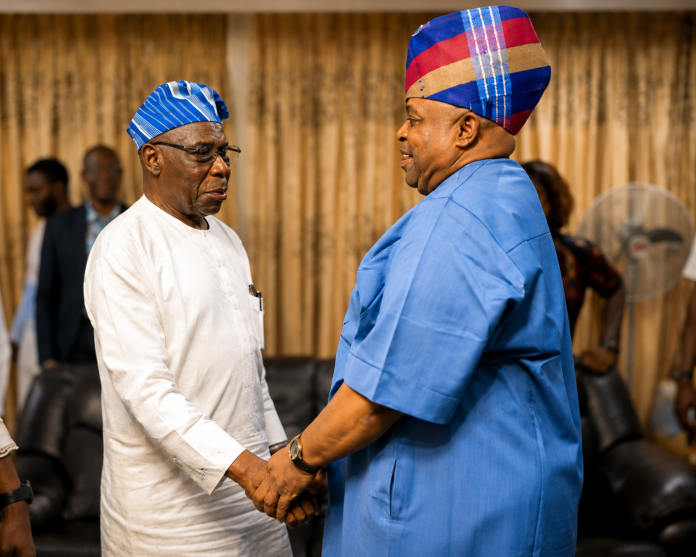
Former Nigerian President Olusegun Obasanjo on Sunday paid a surprise visit to Osun State Governor Ademola Adeleke at the Government House in Osogbo.

Obasanjo’s visit came shortly after the Independent National Electoral Commission (INEC) declared Adeleke the winner of Saturday’s keenly contested governorship election.

In a video currently circulating on social media, Obasanjo was seen dancing with the governor as they celebrated Adeleke’s victory.

Watch video:
https://x.com/i/status/2089086256936333786

Nigerian Newssphere reports that President Bola Tinubu, state governors and other political leaders have sent congratulatory messages to Adeleke following his re-election on Saturday.

The governor had extended an olive branch to his opponents after the election, urging them to join hands with his administration.

However, the All Progressives Congress (APC) said it was still reviewing the results and could take legal steps to challenge the outcome.

Osun election results: Oyebamiji defeats Adeleke at Boluwaduro polling unit

0

Bola Oyebamiji, the All Progressives Congress (APC) governorship candidate, has defeated the incumbent governor and Accord Party candidate, Ademola Adeleke, at a polling unit in Boluwaduro Local Government Area of Osun State.


Oyebamiji secured 68 votes at Ward 6, Polling Unit 006, while Adeleke’s Accord Party polled 39 votes.


According to a result sheet shared by Akinsola Akin on X after the votes were counted, the APC candidate emerged ahead of the incumbent governor at the polling unit.


DAILY POST reports that voting in Saturday’s governorship election, which commenced as early as 9 a.m., ended around 2:30 p.m. at some polling units across the state.


Adeleke, Oyebamiji and 13 other candidates are contesting for the support of 2,339,233 registered voters in the election, according to data from the Independent National Electoral Commission (INEC).


Earlier, DAILY POST reported that Adeleke expressed dissatisfaction with the conduct of the election across the state, alleging that Bimodal Voter Accreditation System (BVAS) machines were malfunctioning or operating slowly at several polling units.


David Adeleke, popularly known as Davido and a nephew of the incumbent governor, also raised concerns over the delay in uploading election results to INEC’s IReV portal.


As of 2:33 p.m. on Saturday, Davido said results were yet to be uploaded to the portal.

Tinubu operates like cult leader, Seyi’s mother is unknown – Dino Melaye spits fire

0
President Tinbu

Former federal lawmaker, Senator Dino Melaye, has accused President Bola Tinubu of running his administration like a capone, a leader of a campus confraternity.


Dino Melaye, who spoke in a recent podcast shared on his X handle, alleged that everything about the president is fake.


According to Melaye, President Tinubu has multiple wives, but only Remi is known, stressing that Seyi Tinubu’s mother is unknown to the public.


He said, “What lesson are we bequeathing to our children with the type of president that we have, where everything is fake and unknown?


“Only a capone operates like that because as a capone, you don’t know where you will sleep.


“You don’t know his wife, you don’t know his children. Seyi’s mother is different from Folasade’s mother; Folasade’s mother is different from the mothers of the other children. All of them have different mothers.


“Apart from Remi Tinubu, do you know any wives of Tinubu? Do you even know Seyi’s mother? How can we continue in sin and ask for grace to abound?”