


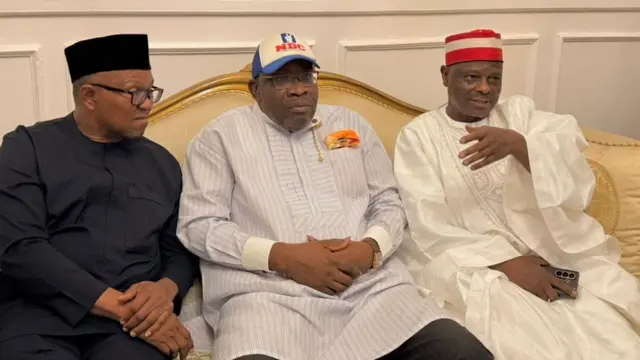
Barely hours after Peter Obi and Rabiu Kwankwaso joined the Nigeria Democratic Congress (NDC), signs of a looming leadership crisis have emerged within the opposition party ahead of 2027 general elections.
Nigerians Newssphere report that before Obi’s defection on Sunday, the NDC had scheduled its state congresses for May 4, 2026. However, party insiders now warn of possible parallel congresses, alleging that supporters of the new entrants are already attempting to take control of the party’s leadership structure.
A source within the party exclusively told Nigerian Newssphere that tensions are rising as the congresses commence. According to the source, the sudden influx of Obi and Kwankwaso loyalists is threatening internal stability. The source also accused the new members of creating avoidable conflicts that could later be blamed on external forces, including the administration of Bola Ahmed Tinubu.
“The states’ congresses will begin today, but Peter Obi and Kwankwaso supporters want to hijack the process barely hours after joining the party. It is terrible. At the end of the day, they would blame President Tinubu for the internal crisis that they caused,” the source said.
Compounding the situation are earlier reports involving the party’s National Legal Adviser, Barrister Reuben Egwuaba, who is alleged to hold dual membership in both the NDC and the Allied Peoples Movement (APM), a violation under Nigeria’s revised electoral laws.
Obi had officially resigned from the African Democratic Congress (ADC) on Sunday, citing undue external influence, while Kwankwaso over the weekend directed his supporters to align with the NDC.
The defections have drawn mixed reactions across the political landscape. Former Bayelsa State governor Seriake Dickson welcomed the move, describing it as a boost for the party. In contrast, former Kaduna senator Shehu Sani argued that the development could ultimately favor President Tinubu’s chances of re-election in 2027.
Political observers note that the exit of Obi and Kwankwaso from the ADC has disrupted earlier efforts by opposition figures to form a united front against the ruling government. Key figures such as Atiku Abubakar, Nasir El-Rufai, and Rotimi Amaechi had, in March 2025, rallied around a coalition aimed at unseating Tinubu.
With the latest political realignments, that coalition appears fractured, leaving the opposition further divided as the 2027 elections draw closer. Since 2023, Obi and several other opposition leaders have switched political platforms multiple times, raising concerns about stability within Nigeria’s opposition bloc.