


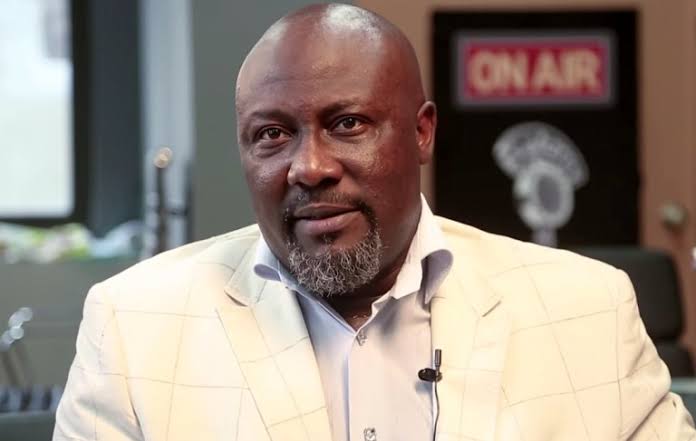
Former Kogi West Senator Dino Melaye has described Nigeria’s persistent electricity challenges as a failure of governance rather than a technical limitation.
In a statement, Melaye lamented that despite over a century of electricity generation, the country still grapples with low output and recurring grid collapses.
“Nigeria has been generating electricity since 1896—over 130 years ago. Yet, as of March 2026, the national grid dropped to just 3,940 megawatts for over 220 million people,” he said.
He compared Nigeria’s performance with other African nations, noting stark disparities in generation capacity.
“South Africa produces over 48,000MW for about 60 million people, while Egypt has roughly 59,000MW installed capacity for 110 million citizens. Nigeria has about 13,000MW installed but can only transmit 4,000 to 5,000MW on a good day. The rest is wasted,” he stated.
Melaye also highlighted the sector’s infrastructure challenges, including repeated grid collapses and vandalism.
“The national grid collapsed 12 times in 2024 alone, while 128 transmission towers were vandalized. Government spent N8.8 billion on repairs,” he said.
Citing data from the Nigerian Electricity Regulatory Commission, he added that between 2010 and 2022, at least 222 partial and total grid collapses were recorded — averaging one every three weeks.
According to him, the financial burden of restoring power after each collapse is enormous.
“Restarting just three power plants — Azura, Delta, and Shiroro — costs about $25 million, equivalent to N42.5 billion, per collapse,” he said.
Melaye further pointed to rising debt in the sector, revealing that power generation companies are owed N6.8 trillion as of February 2026, with the figure increasing by about N200 billion monthly.
He noted that N3.3 trillion of the debt is owed to gas suppliers, leading to reduced gas supply to thermal plants.
“Plants require about 1,630 million standard cubic feet of gas daily but receive only 692 million—less than 43 percent. That’s why the power supply remains poor,” he explained.
The former lawmaker also drew attention to Nigerians’ heavy reliance on generators, estimating that about $14 billion is spent annually on their purchase and fueling.
“Nigeria has about 22 million generators with a combined capacity of 42,000MW — nearly eight times what the national grid delivers,” he said.
Melaye warned that the power crisis is crippling businesses and costing jobs.
“In 2023, 767 manufacturing firms shut down, while 335 became distressed, leading to 18,000 job losses. In the first half of 2025 alone, manufacturers spent N676.6 billion on alternative power, yet still struggled. Another 18,935 jobs were lost,” he noted.
He also cited estimates from the World Bank, which put Nigeria’s annual economic losses from power outages at $29 billion — about 10 percent of the country’s GDP.
Melaye concluded that Nigeria’s electricity challenges reflect deeper structural issues.
“This is not a power problem — it is a governance problem,” he said, adding that countries like Egypt, Ghana, and South Africa have made significant progress through deliberate reforms.
He stressed that Nigeria cannot achieve meaningful industrialization while depending heavily on generators.
“No serious economy runs on generators. Industrial growth cannot be built on backup power,” he added.