advertise with us
Home Blog Page 3

2027 Election: INEC Chairman Amupitan reveals expected outcomes 100 Days to Ballot

0

The Independent National Electoral Commission, INEC, Chairman, Prof Joash Amupitan, on Tuesday, disclosed that Nigeria has 100 days to the commencement of the 2027 general elections.


Amupitan disclosed INEC would ensure the 2027 general election is not only successful but serves as a global benchmark for transparency, integrity and peace.


He made this known during INEC’s world press conference/National stakeholders forum on preparation for the 2027 election.


According to Amupitan: “It’s exactly 100 days to the first ballot of the 2027 general election. This 100-day milestone is not just a countdown; it’s a call to action.


“It marks the beginning of the first phase of our preparations to ensure that the 2027 general election is not only successful but serves as a global benchmark for transparency, integrity and peace.


“Since assuming the mantle of leadership in 2025, this administration has successfully conducted off-cycle elections including Anambra, Ekiti, Osun governorship elections, the FCT council election alongside critical federal and state bye-elections.


“From the reports submitted by local and international observers, everyone of these polls has the benchmark of electoral integrity underscoring our unwavering adherence to operational efficiency and credibility.


“This obstacle provided a vital testing ground for key structural upgrades and they have reaffirmed that the early deployment of adhoc staff and sensitive materials are precision driven, intelligence led security arrangements are the none-negotiable foundation of seamless election delivery.”

BREAKING: 2027: INEC Reveals Top 10 States in Nigeria by Registered Voters

0

The Independent National Electoral Commission (INEC) has released the list of the 10 states with the highest number of registered voters ahead of the January 16th 2027 presidential election.

Lagos State tops the list with 7,488,633 registered voters, according to figures disclosed by INEC Chairman on Tuesday.

The figures were presented during the commission’s World Press Conference in Abuja as part of preparations for the 2027 general elections.

Kano State ranks second with 6,000,570 registered voters, while Kaduna State occupies the third position with 4,000,640.

Katsina State is fourth with 3,876,051 registered voters, followed by Oyo State with 3,588,111.

Delta State ranks sixth with 3,525,988 registered voters.

Benue State is seventh with 3,057,225 registered voters, while Rivers State has 3,000,734.

Ogun State occupies the ninth position with 3,037,981 registered voters.

Bauchi State completes the top 10 with 3,000,047 registered voters.


The figures highlight the states with the largest voter populations ahead of the 2027 general elections.

NCC to expand digital literacy nationwide as DBI gets ITU recognition

0

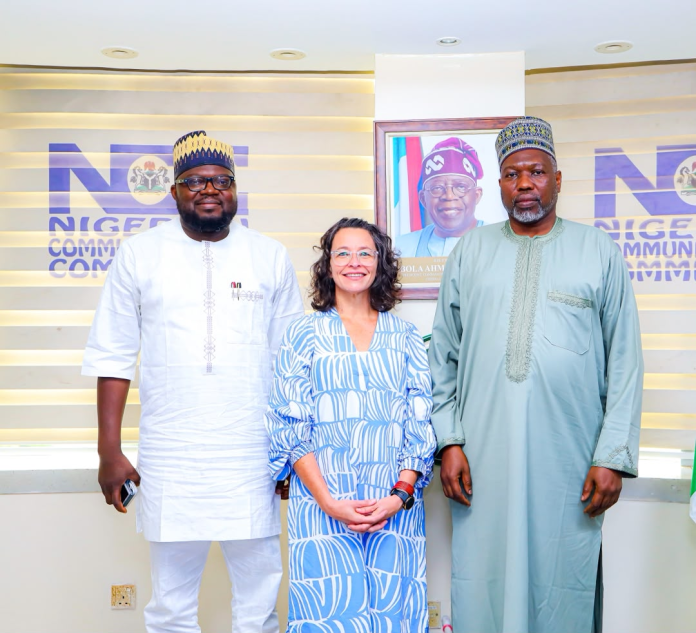
L-R : David Daser, President/CEO, Digital Bridge Institute, Nigeria; Robyn Fysh, Senior Digital Skills Officer, International Telecommunications Union (ITU) Headquarters, Geneva; and Engr. Babagana Digima, Director, Research and Development, Nigerian Communications Commission during a courtesy visit at the Commission’s headquarters on 30th September, 2026.

The Nigerian Communications Commission, NCC says it will leverage the Digital Bridge Institute’s (DBI) designation as an International Telecommunication Union (ITU) Digital Transformation Centre (DTC) to accelerate digital literacy, enhance digital inclusion, and equip more Nigerians with the skills needed to participate effectively in the digital economy.

In a statement on Monday by NCC’s Director of Public Affairs, Mrs. Nnenna Ukoha, the Commission made this known while receiving the Senior Digital Skills Officer of the International Telecommunication Union (ITU), Ms. Robyn Fysh, who paid a courtesy visit to the NCC Head Office in Abuja on Wednesday.

The visit took place on the sidelines of Ms. Fysh’s official engagement in Nigeria. The engagement forms part of her mission to DBI following the Institute’s designation by the ITU as a Digital Transformation Centre (DTC), a recognition that places DBI within a global network of institutions dedicated to advancing digital skills and digital transformation initiatives. DBI also serves as the ITU’s Digital Training Academy (DTA) in Nigeria.

Representing the Executive Vice Chairman and Chief Executive Officer of the NCC, Dr. Aminu Maida, the Director of Research and Development, Engr. Babagana Digima, received Ms. Fysh and members of the DBI delegation led by its President and Chief Executive Officer, Mr. David Daser.

While receiving the delegation, Engr. Digima reaffirmed the Commission’s commitment to innovation, capacity development, and digital transformation. He noted that DBI’s designation as an ITU Digital Transformation Centre presents a significant opportunity to deepen collaboration among the NCC, DBI, and the ITU in advancing digital skills development and digital inclusion across the country.


“DBI’s recognition as an ITU Digital Transformation Centre is a significant milestone for Nigeria’s digital skills ecosystem and an opportunity to expand access to digital literacy and capacity-building programmes across the country,” he said.


Digima stated that the Commission considers digital literacy and capacity building critical enablers of Nigeria’s digital economy aspirations and expressed confidence that DBI’s new designation would further strengthen access to quality digital skills training, particularly for underserved and vulnerable populations.


He described DBI’s dual designation as a landmark achievement that offers Nigeria a unique opportunity to simultaneously tackle digital exclusion and develop globally competitive ICT expertise.


“The NCC remains committed to initiatives that equip Nigerians with the skills needed to participate meaningfully in the digital economy. We will continue to work closely with relevant government agencies, state governments, development partners, and other stakeholders to expand access to digital skills training and ensure that no community is left behind in Nigeria’s digital transformation journey,” he added.


Earlier, Ms. Robyn Fysh commended the longstanding collaboration between the NCC and the ITU in advancing digital development initiatives and promoting digital skills acquisition.


“The ITU values its strong partnership with the NCC and DBI, and we are encouraged by the progress being made to advance digital skills and inclusion in Nigeria,” she said.


She noted that the engagement provided an opportunity for the three organisations to exchange ideas, strengthen collaboration, and explore areas of mutual interest in support of a shared vision of accelerating digital transformation and empowering citizens through digital skills and innovation.


Providing an overview of the programme, Fysh explained that the ITU Digital Transformation Centres initiative, launched in partnership with Cisco in 2019, has reached more than 870,000 participants globally, with women accounting for more than half of the beneficiaries. She said the programme is focused on equipping individuals in underserved communities with practical skills that improve employability, entrepreneurship, and participation in the digital economy.


“DBI’s new status as a Digital Transformation Centre will help strengthen efforts to empower more people with relevant digital skills and opportunities,” Fysh added.


Also speaking, the President of DBI, Mr. David Daser, expressed appreciation to the management of the NCC for its unwavering support, which enabled the Institute to pursue and attain its recognition by the ITU as a Digital Transformation Centre.


“This achievement reflects the confidence of the ITU in DBI and the unwavering support of the NCC in advancing digital capacity development in Nigeria,” he said.

Daser noted that the Institute recently achieved a historic milestone by becoming the first institution globally to simultaneously hold the status of an ITU Academy Training Centre (ATC) and an ITU Digital Transformation Centre (DTC), following support received from the NCC.

He stressed the importance of the NCC’s continued involvement in scaling the initiative nationwide.


“As a prominent state actor, the NCC can help drive this agenda by leveraging its infrastructure, networks, and partnerships to extend digital skills training and certification opportunities to underserved communities nationwide,” he said.


Daser further noted that the initiative aligns with the objectives of Nigeria’s National Digital Literacy Framework, which targets 95 per cent digital literacy by 2030. Achieving that goal will require stronger collaboration and sustained investment in digital skills development, particularly for underserved populations.


He acknowledged the pivotal role played by the Commission throughout the journey, describing the achievement as a testament to the shared commitment of both institutions to strengthening Nigeria’s digital capacity and positioning the country as a leading hub for digital skills development in Africa.


“As a Digital Transformation Centre, we are better positioned to expand our impact and support the development of a digitally skilled workforce for Nigeria and Africa,” he added.

Dukawa: NNPCL’s N11.2tn energy Security spending raises fresh questions over subsidy removal

0

Has President Bola Tinubu’s economic reform programme truly laid the foundation for prosperity, as the administration repeatedly argues? The next phase, the President says, should make that prosperity visible in Nigerians’ daily lives through lower living costs, more jobs, higher production, greater opportunities and rising household incomes.

That promise now faces a decisive test: Are Nigerians beginning to see the rewards of reform, and where exactly are the savings from subsidy removal going?

When petrol subsidy was removed in 2023, Nigerians were told the policy would eliminate waste, protect public finances and redirect scarce resources towards development. Citizens were asked to endure higher transport fares, rising food prices and increased household costs in the expectation that the sacrifice would eventually produce a stronger economy.

Three years later, that argument requires a rigorous public audit.

The latest financial disclosures from the Nigerian National Petroleum Company Limited (NNPC) raise difficult questions. NNPC’s 2025 audited accounts show N11.2 trillion in receivables from the Federation, representing costs and advances incurred on behalf of the government, including expenditure associated with securing the country’s oil and gas assets. That is about 57 per cent higher than the N7.13 trillion energy-security expense recognised in 2024.

There is an important distinction: the N11.2 trillion should not be interpreted as N11.2 trillion in new petrol subsidy spending in 2025. NNPC says no new energy-security expense was recognised during the year after reconciliation with government agencies. Nevertheless, its accounts show an energy-security-cost balance of about ₦8.67 trillion, alongside other amounts owed by the Federation.


That distinction is important, but it does not resolve the accountability issue. Instead, it underscores the need for greater transparency.


From petrol subsidy to energy-security expenditure


For years, the government defended petrol subsidy as a way to shield Nigerians from the full cost of petroleum products. Critics countered that the system was expensive, inefficient and vulnerable to abuse.


In 2023, the subsidy regime was effectively dismantled. The case for doing so was straightforward: Nigeria could no longer afford to keep petrol artificially cheap while infrastructure, healthcare, education, electricity and social services remained underfunded.


Yet NNPC’s 2024 accounts reported ₦7.13 trillion in energy-security expenditure, compared with ₦4.8 trillion in 2023. The expenditure was widely associated with petrol subsidy or under-recovery.


Since then, the terminology has become more complex.


Energy-security costs, advances, Federation receivables and spending to protect oil and gas infrastructure now overlap in public discussions.


For ordinary Nigerians, however, the labels matter less than the scale of the obligation.


Changing the classification of expenditure does not eliminate the obligation to explain it.


Energy security is necessary—but not a blank cheque


There is no serious argument against protecting Nigeria’s oil and gas infrastructure. Oil theft, pipeline vandalism and attacks on petroleum facilities have cost the country billions of dollars.


NNPC says improved pipeline security helped increase production, with crude oil and condensate output reaching 1.77 million barrels per day in 2025, the highest level in five years. If security spending prevents theft, protects pipelines and raises production and government revenue, it has a compelling economic justification.


But a legitimate objective does not automatically justify every naira spent in its name.


The questions are straightforward: How much is being spent? Who receives the money? Under what contracts? Through what procurement process? What work was performed? Who verified it? What losses were prevented? And how much additional revenue did the spending generate?


When expenditure reaches trillions of naira, these are not optional inquiries.


They are the minimum requirements of public accountability.


Nigerians deserve to see the beneficiaries


If the government spends billions or trillions protecting national assets, citizens should be able to trace the money from authorisation to the final beneficiary.


They should know the companies involved, the nature and duration of their contracts, the amounts paid, the expected outcomes and whether those outcomes were independently verified.


National-security concerns may legitimately restrict disclosure of sensitive operational details. But security cannot become a blanket justification for financial opacity.


The government can protect sensitive information while still publishing aggregate expenditure, procurement procedures, contract values, beneficiaries, audit findings and measurable outcomes.


Where are the subsidy savings?


The Federal Government has explained the savings generated by subsidy removal and how additional revenues have been shared among the three tiers of government. But those figures matter to Nigerians only if the money produces visible improvements in their lives.


The central question is therefore not simply how much the government saved, but what those savings have achieved.


Where is the evidence in better infrastructure, stronger social protection, improved public services and greater economic opportunity?


If subsidy removal generated substantial fiscal savings, how much went into infrastructure? How much went into social intervention, debt servicing and security? How much reached households directly? And how much ultimately went to contractors and corporate beneficiaries?


As the government asks citizens to endure painful economic adjustments, it must demonstrate, in figures ordinary people can understand, what those sacrifices have produced.


NNPC’s stronger finances make the question more important


The issue is even more significant in light of NNPC’s improved financial performance.


NNPC reported ₦7.2 trillion in profit after tax in 2025, up from ₦5.4 trillion in 2024. It also reported ₦34.5 trillion in revenue and said taxes, royalties and other remittances to the government increased by 39 per cent to ₦22.3 trillion.


These figures demonstrate the enormous financial potential of Nigeria’s petroleum sector. They also make institutional clarity indispensable.


If NNPC operates as a commercial entity under the Petroleum Industry Act while simultaneously incurring substantial costs on behalf of the Federation, Nigerians deserve a clear distinction between its commercial expenditure and spending undertaken as an agent of the government.


Without that distinction, taxpayers cannot easily determine which costs belong to NNPC, which belong to the Federation and which ultimately become public liabilities.

The real test of subsidy removal

The success of subsidy removal should not be measured simply by whether the government stopped paying one particular subsidy.

It should be measured by whether the resources previously consumed by the subsidy are producing better economic outcomes for Nigerians.

If citizens pay more for petrol, transport, food and other essentials while the government continues to assume substantial petroleum-related obligations, there must be a convincing explanation of where the corresponding public value is being created.

Nigeria should therefore establish a public-benefit test for major energy-security expenditure. Every major project should answer five questions:

What problem is being solved? How much public money is committed? Who receives it? What measurable outcome is expected? What independent evidence shows that the outcome was achieved?

The N11.2 trillion figure should prompt more than another political argument. It should trigger a detailed public accounting.

The Federal Government and NNPC should publish a full, independently verified account of the N11.2 trillion receivable and N8.67 trillion energy-security balance, including relevant contracts, beneficiaries, procurement processes, audit findings and measurable results.

The National Assembly and the Auditor-General should subject the figures to rigorous public scrutiny, recover any improperly spent funds and hold responsible officials and contractors accountable.

Subsidy removal cannot be defended as fiscal reform if one opaque petroleum obligation is simply replaced by another.

Energy security is essential, but it must not become a blank cheque, a substitute subsidy or a mechanism for transferring public wealth to undisclosed beneficiaries.

Until Nigerians can see where the money went, what it achieved and who benefited, the promised dividends of subsidy removal will remain more a matter of faith than evidence.

Abba Dukawa writes from Abuja and can be reached at abbahydukawa@gmail.com.

NCC moves to publish Digital Connectivity Index, finalise Direct-to-Device Framework

0
EVC NCC, Aminu Maida

The Nigerian Communications Commission, NCC, has been urged to publish the first national Nigeria Digital Connectivity Index report, advance open-access and wholesale regulation, and finalise the direct-to-device framework.

The recommendations were contained in a communiqué issued at the end of the Nigeria Digital Connectivity Investment Forum 2026, organised by the NCC in partnership with Swedfund and Ookla in Abuja.

The forum was held from September 29 to 30, 2026, with the theme, “Unlocking Infrastructure Investment through Data, Transparency and Partnerships.”

Participants also urged the Commission to sustain reforms aimed at improving investment conditions in Nigeria’s digital infrastructure sector, including tariff realignment, designation of critical national information infrastructure and engagement with state governments on Right of Way.

The forum brought together government officials, regulators, investors, financiers, infrastructure providers, mobile network operators, tower and fibre companies, satellite and fixed wireless providers, original equipment manufacturers and industry associations.

According to the communiqué signed by NCC director of public Affairss Nnnena Ukoha, the forum provided a platform for stakeholders to examine investment opportunities in Nigeria’s digital infrastructure sector, identify barriers to deployment and financing, and agree on practical actions to accelerate investment and expand meaningful connectivity.


Participants observed that Nigeria consumed about 1.6 million terabytes of data in July 2026, representing an increase of almost 47 percent in 12 months.


They projected that subscriptions would grow from about 195 million to 350 million within the next 10 to 15 years, while cloud computing and artificial intelligence would further increase demand for networks, data centres and power.


The forum observed that “demand is outgrowing the networks,” stressing that the growing adoption of cloud computing and artificial intelligence would place additional pressure on digital infrastructure and power supply.


It identified power and middle-mile connectivity as major constraints to digital infrastructure deployment.


According to the communiqué, “power and the middle mile are the binding constraints on deployment,” with stakeholders noting that the cost of inland connectivity was limiting data centre and internet service investments to a few metropolitan areas.


Participants therefore recommended that energy and connectivity investments be planned together, with tower clusters recognised as anchor off-takers for distributed generation.


The forum further noted that mobile broadband currently covers about 90 percent of Nigerians, while smartphone ownership stands at about 27 percent and broadband penetration at 57.4 percent, against a 70 percent target.


It stated that “usage, rather than coverage, is now the larger gap,” stressing that device affordability, digital skills and trust remained major constraints to meaningful connectivity.


Participants said coverage investment alone could not close Nigeria’s digital divide.


The forum consequently recommended that the Federal Government accelerate the delivery of Project BRIDGE, the 90,000km national fibre backbone, as a strategic response to the middle-mile connectivity gap.


It also called for measures to improve the availability and reliability of power for digital infrastructure, sustain policy consistency and support financing structures capable of reducing the cost of capital in the sector.


On Right of Way, state governments were urged to reduce and harmonise Right of Way and site permit charges, adopt the federal model under which operators that lay fibre reinstate roads, and shorten permitting timelines.


The forum noted that Right of Way reforms had translated into fibre growth of between 22 percent and 95 percent in reforming states, with 12 states now charging zero Right of Way fees, compared with seven in December 2024.


Participants also recommended that operators, infrastructure and technology companies pursue shared infrastructure and neutral-host models to reduce the cost of rural and indoor coverage.


They urged operators to pair coverage investment with measures that put affordable devices in users’ hands, including locally manufactured devices and SIMs.


Investors and development finance institutions were advised to match long-life digital infrastructure assets with long-tenor naira capital and tie infrastructure funding to independently verified network performance.


The forum further recommended blended financing structures and credit enhancement to bring projects that are not yet commercially ready to market.


Participants agreed on priority actions to be implemented within six to 24 months.


The actions include securing funding for community co-owned rural networks powered by renewable energy in zero-connectivity communities, issuing open-access and wholesale regulations, publishing a wholesale rate card and completing broadband mapping.


Other proposed measures include giving the Universal Service Fund regulatory backing as the primary source for underserved-area projects, developing indoor coverage models and incorporating data-centre requirements into the National Broadband Plan.


Within 18 to 24 months, stakeholders proposed establishing a financing framework for telecommunications power and developing metro and access fibre under concession, mapped against existing assets and integrated with Project BRIDGE.


The forum noted that “the principal barriers identified across the Forum—the cost and tenor of financing, Right of Way and permitting constraints, the cost and reliability of power, and gaps in trusted infrastructure data—are interconnected and require coordinated action.”


It therefore called for coordinated action among government, regulators, investors, financiers and industry stakeholders to address the challenges.


The NCC undertook to sustain engagement with participants and relevant stakeholders towards advancing the identified actions and investment pathways.

BBNaija Season 11: Temi Nkem wins N160m grand prize

0

Temi Nkem has won Big Brother Naija Season 11, taking home the grand prize of N160 million.

She will also go home with N90,000 in cash prizes and other prizes.

Temi Nkem, Sheba and Aikou emerged as the top three finalists during Sunday’s grand finale.

According to the poll, Aikou came second to Temi Nkem, while Sheba finished third.


Earlier, nine housemates, including Tram, Flora and Oyin, made it to the final day.

BBNaija 11: Sheba, Temi Nkem, Aikou emerge as top 3 finalists

0

Sheba, Temi Nkem and Aikou have emerged as the top three housemates of Big Brother Naija Season 11.

This comes as Tram, Flora, Oyin, Barry and Bludtopia were evicted on Sunday during the grand finale.

With the development, Sheba, Temi Nkem and Aikou are left to battle for the N160 million grand prize.

Earlier, Nigerian Newssphere reported that Barry became the first housemate to be evicted from the top nine.

Oyin and Flora followed suit in the eviction spree.

Thereafter, Tram and Bludtopia were also evicted.

BBNaija 11 finals: Barry, Oyin, Flora, Tram evicted from show

0

Barry, Oyin, Flora and Tram have been evicted from the ongoing BBNaija Season 11 reality show.

Barry, Oyin, Flora and Tram were evicted during the grand finale live ceremony on Sunday evening after spending 70 days on the show.

As the grand finale continues, the show left four contestants in the house to battle for the N160 million grand prize.

Nigerian Newssphere reports that Barry won the Head of House (HoH) title twice on the show and held the Ultimate Veto Power.

After Barry’s eviction, Oyin, Flora and Tram were also evicted from the show.

The remaining finalists are Bluethopia, Aikou, Ricky, Sheba, Temi Nkem.

Recall that Keivo was disqualified after physical fight with Tram.

2027: Labour Party youth leaders move to collapse structure for Tinubu, APC nationwide

0
President Tinubu

Labour Party youth leaders have announced plans to collapse their structure for President Bola Ahmed Tinubu and the ruling All Progressives Congress (APC) ahead of the 2027 presidential election.

The decision was contained in a statement on Saturday by the LP Edo State Youth Leader, Comrade Ken Omusi.

He said the move followed a virtual meeting held on October 2, 2026, at 8:30 p.m., involving the Labour Party National Youth Leader, Prince Kennedy Ahanotu, members of the National Youth Leadership, National Zonal Youth Leaders and State Youth Leaders.

Read the full statement below:

FOR IMMEDIATE RELEASE

LABOUR PARTY YOUTH LEADERS PROPOSE ALIGNMENT WITH APC TO SUPPORT PRESIDENT TINUBU’S RE-ELECTION WITH CITY BOY MOVEMENT AND TINUBU SUPPORT GROUP

Abuja, Nigeria – The Youth Wing of the Labour Party has initiated discussions on a proposed political alignment with the ruling All Progressives Congress (APC), the Renewed Hope Movement, the City Boy Movement and Tinubu Support Groups to declare support for the re-election of President Bola Ahmed Tinubu, GCFR.


The proposal emerged during a virtual meeting held on October 2, 2026, at 8:30 p.m., involving the Labour Party National Youth Leader, Prince Kennedy Ahanotu, members of the National Youth Leadership, National Zonal Youth Leaders and State Youth Leaders. Participants deliberated on the party’s political direction, given the prolonged crisis and the future of youth participation in national governance ahead of the 2027 general elections.


During the meeting, several youth leaders expressed concerns about what they described as inadequate recognition, total neglect, lack of engagement and lack of support for the youth constituency during and after the 2023 general elections, where they laboured in vain for a presidential candidate who lacked the skills to consolidate. They emphasised the need for a political platform and leader that would provide greater opportunities for youth participation, leadership development, economic empowerment and inclusion in national decision-making.


The meeting also featured discussions on the policies and programmes of President Bola Ahmed Tinubu’s administration, particularly in the areas of human capital development, youth empowerment, economic reforms, infrastructure, healthcare, education, security, agriculture and workers’ welfare. Participants expressed varying views on these issues and their potential implications for Nigeria’s sustainable development.


Following extensive deliberations, the youth leaders called on the National Youth Leader, Prince Kennedy Ahanotu, to commence, with immediate effect, consultations with relevant stakeholders within the APC, the Renewed Hope Movement, the City Boy Movement and the Tinubu Support Group to explore the prospects of political alignment and possible collaboration ahead of the 2027 elections.


The participants also expressed confidence in Prince Kennedy Ahanotu’s leadership and mandated him to facilitate the proposed alignment, while emphasising the importance of broad-based consultations and consensus-building among the youth leadership.


The meeting further proposed a physical gathering of Labour Party youth leaders in Abuja on a mutually agreed date to review the outcome of the consultations and determine the next steps regarding the proposed political realignment.


The proposed engagement represents an ongoing dialogue within the Labour Party’s youth constituency on political participation, strategic partnerships and the role of young Nigerians in shaping the country’s political and developmental future.

Signed:

Comrade Ken Omusi

Edo State Youth Leader

For ALL in Attendance

Prince Kennedy Ahanotu, 5 National Zonal Youth Leaders and 32 State Youth Leaders.

Labour Party, Nigeria


‘Tinubu gravely ill’ — Mike Arnold writes Trump ahead of 2027 election

0

Former United States mayor and public commentator Mike Arnold has raised concerns about President Bola Ahmed Tinubu’s health and warned of possible political instability in Nigeria if the President dies before the 2027 general election.

Arnold made the claims in a briefing he said he submitted to an individual who advises US President Donald Trump on international security.


According to Arnold, the briefing is circulated among officials in the White House, the US Department of State and the Defence Intelligence Agency (DIA), among others.

In the statement, Arnold alleged that Tinubu was “gravely ill” and accused the Nigerian government of concealing the President’s health condition.

He cited Tinubu’s extended foreign trip, his absence from the United Nations General Assembly, observations about his movement and questions surrounding his recent national broadcast as reasons for his concerns.

Arnold also referenced an earlier controversy involving an image of Tinubu allegedly generated by artificial intelligence, claiming that it was circulated as an authentic image of the President.

He further alleged that there was a period when Nigerians were uncertain about who was effectively running the country.

Arnold warned that if Tinubu dies before January 16, 2027, there could be an immediate struggle for political control and possible violence.

He also raised concerns about the constitutional succession that would follow a possible death or incapacity of the President, focusing particularly on Vice President Kashim Shettima’s Kanuri background and what he described as tensions between different power blocs in northern Nigeria.

Arnold made a series of allegations linking political developments involving Shettima to the Boko Haram insurgency. He cited the 2012 arrest and subsequent escape of Kabiru Sokoto, who was accused in connection with the 2011 Madalla Christmas Day church bombing, and noted that Shettima was governor of Borno State at the time.

However, Arnold did not provide evidence establishing a connection between Shettima and Boko Haram.

He also drew a comparison between the current situation and the illness of former President Umaru Musa Yar’Adua, whose prolonged absence from office triggered a constitutional and political crisis in 2010.

Arnold claimed that Boko Haram escalated its insurgency months after Yar’Adua’s death, pointing to the 2009 prison break in Bauchi as part of the subsequent deterioration of security.

He described Boko Haram and the historic Sokoto Caliphate as opposing forces and warned that a major political crisis following Tinubu’s death could have severe consequences for Nigeria.

Arnold called on the US government to establish the state of Tinubu’s health and publicly communicate its interest in a stable Nigeria and a credible election.

“Bola Tinubu is gravely ill and his government is hiding it badly. A three-week trip extended twice. A third straight UN General Assembly missed. A limp left arm. Not steady on his feet. An official broadcast so cut and spliced that Nigerians counted the edits. Earlier this year, a Grok image of the president was put out as the real thing.

“Find out how sick he is. Then say plainly that America intends to see a stable Nigeria and an honest election — and that we are watching right now,” he said.

Nigeria is scheduled to hold its next presidential election on January 16, 2027, with Tinubu and seventeen other candidates contesting the election.

Nigerian Newssphere reports that Mike Arnold has always been pro-Biafra.