


By Moses Olili
Fear and panic now grip residents of the Federal Capital Territory whenever dark clouds gather and rain appears imminent. What should ordinarily be a welcome relief from Abuja’s heat has increasingly become a source of apprehension for residents who have learnt, sometimes painfully, that a heavy downpour can alter the character of the city within minutes.
People are no longer entirely at ease when the skies turn dark. They begin to wonder which roads may become impassable, which neighbourhoods could be affected and whether they will get home before the floodwater arrives. For some motorists, the calculation is even more immediate: whether to proceed with a journey or turn back before a familiar road becomes a dangerous stretch of rushing water.
It is a rare and troubling reality for a city that was deliberately conceived as a planned capital, with its districts, roads, green spaces, drainage corridors and other components of the urban environment designed to function within a defined framework.
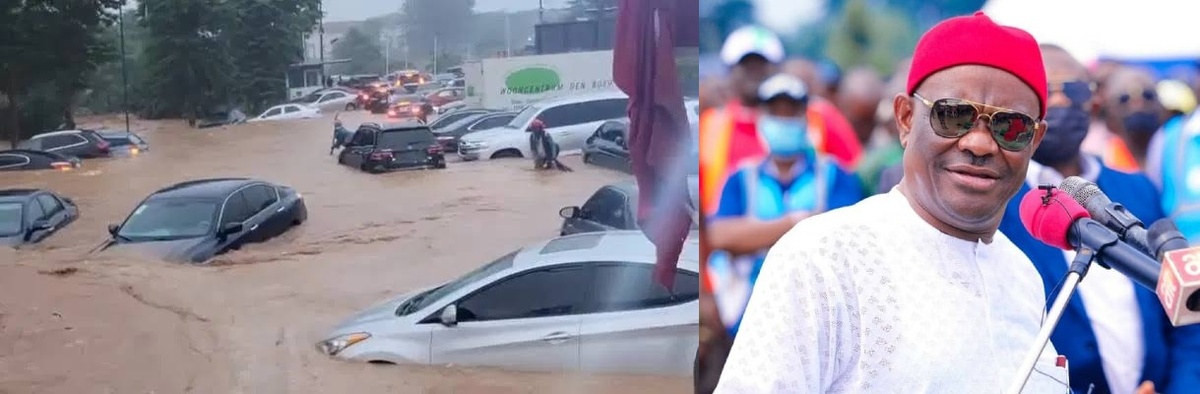
The events of August 15 brought this growing anxiety into sharp focus. Following a heavy downpour, several parts of Abuja were inundated, with flooding reported in Wuse 2, Gudu, Lokogoma, Katampe, Mabushi, Lugbe, Nyanya, Gwarinpa, Asokoro, Maitama, Utako, Wuye and around the bridge linking Gaduwa and Durumi. Motorists were stranded, vehicles were caught in floodwater, and some residential and commercial properties were affected.
For years, flooding in Abuja has often been associated with places such as Lokogoma, Trademore and other rapidly developing areas on the outskirts of the capital. The latest incident, however, brought the problem closer to the city’s established districts, including areas many residents associate with Abuja’s best-planned and most developed neighbourhoods. That alone should make the recent flooding more than another seasonal inconvenience to be forgotten when the roads eventually dry.
The more important question is not simply why Abuja flooded after a heavy rainfall. Cities flood, and even well-planned cities can be overwhelmed by extreme weather. The question that deserves greater attention is whether Abuja’s rapid expansion and changing pattern of development are making the city less capable of absorbing and directing the water it receives.
That question has become particularly relevant following the renewed controversy over the use of green areas, waterways and other spaces that were originally intended to serve environmental and public purposes.
A city designed with nature in mind
Abuja’s story is different from that of most Nigerian cities. It was conceived as a purpose-built federal capital, and its planners sought to incorporate the natural landscape into the structure of the city rather than simply build over it. The Master Plan was completed in 1979 and was intended to provide the framework for the city’s physical development, infrastructure and land use. The plan is now undergoing review because of changes in population, urban expansion and other realities that were not anticipated when it was first conceived.
This history matters because the green spaces, parks, drainage corridors and waterways scattered across Abuja were not necessarily spaces that had simply been left unused. Many formed part of the environmental logic of the city. They provided room for recreation, vegetation, drainage and, in some cases, the natural movement and absorption of stormwater.
As Abuja has expanded, however, pressure on land has increased. Residential estates, commercial buildings, roads, car lots and other developments have progressively transformed parts of the city’s landscape. Urban growth is inevitable, but the question is whether that growth has always respected the environmental limitations and planning principles upon which Abuja was originally built.
Recent research on the Federal Capital City has pointed to substantial changes in land use, including the expansion of built-up areas and a corresponding reduction in vegetation and other natural land cover. The research also identified increased surface runoff and significant areas vulnerable to the accumulation of stormwater. These findings provide an important context for understanding why intense rainfall can have increasingly disruptive consequences in a city that continues to expand.
The implication is not that every new building in Abuja causes flooding, nor that every flood can be traced to a particular development. Rather, the concern is that the cumulative effect of urbanisation, paved surfaces, drainage limitations and the loss or obstruction of natural pathways for water can make a city increasingly vulnerable when intense rainfall occurs.
The rain is only part of the problem
It would be simplistic to blame Abuja’s flooding entirely on construction or the activities of the FCT Administration. Rainfall intensity remains an important factor, and the Nigeria Meteorological Agency has continued to issue flash-flood risk information based on factors including forecast rainfall intensity, soil moisture, drainage capacity, terrain and other hydrological considerations. NiMet’s August 21–31 flash-flood outlook, published on August 24, specifically identified these factors in assessing areas potentially vulnerable to flash flooding.
That means Abuja must be prepared for heavy rainfall regardless of how effectively its planning regulations are enforced. A drainage system can be properly designed and still be overwhelmed by an exceptional downpour. But the existence of extreme rainfall does not remove the responsibility to ensure that the city has adequate drainage, functioning waterways and sufficient open areas to manage the volume of water reaching the ground.
Indeed, NiMet’s own assessment recognises drainage capacity as one of the factors that determine flood vulnerability. The issue, therefore, is not whether the rain should be blamed or absolved. It is whether the city has been adequately prepared for the rain it is already receiving.
When a natural waterway is obstructed, when drainage channels are narrowed, when refuse blocks the passage of water or when large areas of soil are replaced with concrete, the consequences of heavy rainfall can become considerably worse. Water that might otherwise have infiltrated the ground or followed a natural drainage route is forced to find another path, and that path may be a major road, a residential neighbourhood or a commercial property.
This is why the flooding debate needs to move beyond the familiar explanation that Abuja simply experienced a heavy downpour. The rain may be the immediate trigger, but the severity of its consequences is also influenced by what has happened to the city before the rain arrives.
The green areas controversy
The issue came to the forefront after the August 15 flooding, when FCT Minister Nyesom Wike ordered the demolition of structures obstructing designated waterways and drainage channels. The minister, after inspecting affected locations, directed that structures found to be blocking water channels be removed and said the exercise would extend beyond Maitama to other parts of the Federal Capital Territory.
The administration subsequently went further by directing that green areas, parks and gardens should no longer be used as car dealership lots. Wike also ordered an investigation into officials suspected of granting illegal approvals for the conversion of such spaces, with directors in departments including Parks and Recreation, Environmental Protection, Traffic Management and Urban Affairs reportedly summoned as part of the inquiry.
The directives are significant because they acknowledge that the use and alteration of land designated for environmental or recreational purposes cannot be treated as a purely commercial matter. The controversy, however, did not end with the orders.
A report published by News Express found that, one week after Wike’s directive, construction and other forms of development remained visible in areas identified as green spaces and waterways in parts of the capital. The report pointed to locations including Maitama Extension, Wuse, Durumi, Gaduwa and Gudu, raising questions about the extent to which enforcement can reverse years of development and land-use changes.
That development introduces perhaps the most important question in the entire debate: how did structures that allegedly obstruct waterways or occupy protected green areas get there in the first place?
If the developments are illegal, there should be accountability not only for those who built them but also for any official or institution that permitted them to proceed. If they were lawfully approved, the authorities need to explain how such approvals were consistent with the city’s planning and environmental requirements. Without answering these questions, demolition becomes little more than a reaction to the consequences of a problem that should have been prevented much earlier.
Abuja’s drainage system under pressure
There is another part of the problem that should not be overlooked: the condition and capacity of the drainage system itself.
Abuja has grown considerably since its original planning. Population has increased, residential districts have expanded, commercial activity has intensified, and areas that were once relatively open have become densely developed. A drainage system designed for a smaller and less intensively built city cannot simply be assumed to remain adequate indefinitely.
At the same time, the effectiveness of existing drains is affected by maintenance. Where channels are filled with sand, refuse or other debris, their ability to carry stormwater is reduced. In some places, residents themselves contribute to the problem through indiscriminate disposal of waste, while in others the issue may be inadequate maintenance or insufficient drainage infrastructure.
This is why the responsibility cannot be placed entirely on government or entirely on residents. Government has a duty to provide and maintain infrastructure capable of serving the population, while residents and businesses have a responsibility not to obstruct that infrastructure through irresponsible waste disposal. Developers, meanwhile, have an obligation to respect planning requirements and avoid construction that interferes with waterways or drainage corridors.
The failure of any one of these responsibilities can create problems. The failure of several at the same time can turn heavy rainfall into a disaster.
What the flooding says about development control
The controversy over Abuja’s green spaces ultimately leads back to the issue of development control.
Urban planning is effective only when there is a credible system for determining what can be built, where it can be built and under what conditions. Once that system becomes weak, inconsistent or vulnerable to influence, the physical consequences eventually become visible.
This is why the FCT Administration’s investigation into alleged illegal approvals is potentially more important than the immediate demolition exercise. If officials approved the use of spaces reserved for parks, gardens or other environmental purposes without proper authority, the public deserves to know how that happened and what measures will be taken to prevent a recurrence.
There is also a need for consistency. Enforcement should not begin only after flooding has generated public outrage. Developers and property owners should know beforehand that construction on a designated waterway or flood channel will not be tolerated, regardless of who owns the property or how much money has already been invested.
At the same time, enforcement must be based on clear planning records and technical assessments rather than arbitrary demolition. If the authorities are going to remove structures, they must be able to demonstrate that the structures are indeed in violation of applicable planning or environmental requirements. This is necessary not only for fairness but also for public confidence in the exercise.
The uncomfortable question of responsibility
The political temptation in a situation like this is to find one person to blame. Since Wike is the current FCT Minister, it is understandable that much of the public conversation has centred on him. Critics have accused the administration of allowing development on green areas and waterways, while supporters have pointed out that Abuja’s flooding problems long predate the current administration.
Both arguments contain elements that deserve consideration.
Abuja’s flooding problem did not begin in 2026, and it would be inaccurate to attribute every drainage or planning failure in the capital to the present administration. The city has experienced years of rapid urbanisation and land-use changes under successive administrations.
At the same time, the fact that a problem predates the current administration does not make the present administration irrelevant to its solution. The FCT Administration is responsible for planning and development control today, and it has the authority to enforce regulations, protect waterways, maintain infrastructure and investigate alleged violations.
The most useful question, therefore, is not whether Wike personally caused the flooding. It is whether the administration has a credible plan to address the conditions that make Abuja vulnerable and whether it is prepared to enforce that plan consistently.
That is a standard by which the administration should be judged.
The economic cost that does not always make the headlines
The consequences of flooding extend beyond the dramatic images of submerged vehicles that circulate on social media.
A flooded road means lost working hours, delayed deliveries and disrupted commercial activity. A damaged vehicle can represent a substantial financial loss to its owner, while a flooded shop or home can destroy property and goods accumulated over many years. Government, too, bears the cost of repairing roads and other infrastructure damaged by repeated flooding.
For businesses, the uncertainty can be just as damaging as the immediate physical losses. When employees cannot reach their workplaces, customers cannot travel and goods cannot move efficiently, economic activity suffers.
This is why flood prevention should not be viewed simply as an environmental responsibility. It is also an economic necessity. Money spent on proper drainage, maintenance, flood mapping, environmental protection and effective development control can prevent much greater losses later.
The same logic applies to green areas. If a natural drainage corridor is destroyed for short-term commercial development, the cost of replacing its environmental function may eventually be far greater than whatever economic benefit the development initially generated.
A city preparing for its future
The current review of Abuja’s Master Plan provides an opportunity to address some of these challenges comprehensively. The Federal Capital Development Authority has acknowledged that the city’s circumstances have changed significantly since the original plan was developed, with population growth, urban expansion and changing socioeconomic conditions creating new pressures. The review, which involves technical cooperation with Japan’s JICA, is expected to take two years.
The review should therefore not be treated simply as an exercise in redrawing maps. It should answer difficult questions about how Abuja will accommodate further population growth without destroying the environmental systems that make the city liveable.
Where should future development occur? Which waterways and floodplains must be protected absolutely? Which green areas should remain public? Are existing drainage systems adequate for the city’s current population and built environment? Which areas have become too vulnerable for further development? How should satellite settlements be incorporated into a wider flood-management strategy?
These questions are more important than simply deciding where the next road or housing estate should be built.
A master plan is useful only to the extent that it reflects reality and is enforced. Abuja does not merely need another plan that looks impressive on paper; it needs institutions capable of ensuring that the plan survives contact with powerful interests, commercial pressures and the constant demand for land.
The rain will return
Perhaps the most troubling development is the change in how residents now perceive rainfall. In a city where the heat can be intense for much of the year, rain has traditionally been welcomed as relief. Increasingly, however, a darkening sky can trigger calculations about traffic, roads, drainage and the possibility of being stranded.
That psychological shift should not be ignored.
Residents should not have to know which roads to avoid every time a storm approaches because they have learnt from experience where flooding is likely to occur. They should not have to decide whether to leave work early because they are uncertain whether a familiar route will remain passable. Nor should businesses have to factor the possibility of flood disruption into the ordinary routine of operating in the nation’s capital.
Abuja cannot prevent heavy rainfall, and it cannot eliminate every risk associated with extreme weather. What it can do is determine how much damage that rainfall causes. That requires protecting waterways and green areas, maintaining and expanding drainage infrastructure where necessary, enforcing development regulations, improving waste management and using available meteorological and hydrological information to prepare before extreme rainfall occurs.
Most importantly, it requires a change from reactive to preventive governance. Waiting until floodwater has entered homes, submerged vehicles and paralysed roads before taking action is costly and unsustainable. The objective should be to identify vulnerabilities when the roads are still dry and correct them before the next storm exposes them.
The recent flooding has therefore presented Abuja with an opportunity as much as a crisis. The controversy surrounding green areas, the demolition of structures obstructing waterways, the investigation into alleged illegal approvals and the ongoing review of the Master Plan have all converged at a moment when the capital can no longer afford to treat flooding as an occasional inconvenience.
For Abuja’s residents, the issue is becoming increasingly personal. Every approaching storm now carries an uncomfortable question: what part of the city will be affected this time?
That is not how a modern capital should make its residents feel.
The answer, however, will not be found in blaming the rain, nor in demolishing structures only after flooding has occurred. It lies in recognising that Abuja’s resilience depends on the relationship between its natural environment, its infrastructure and the way its land is developed. If waterways are protected, drainage systems maintained, green spaces preserved and planning regulations enforced before violations become entrenched, the city will be far better positioned to withstand the increasingly intense rainfall that climate and weather patterns may bring.
The rain will continue to fall. Abuja’s real challenge is to ensure that when it does, the city remains capable of receiving it without turning its roads into rivers and its residents into reluctant spectators of another avoidable crisis.
For a capital that was planned from the beginning around the relationship between people, infrastructure and the environment, that should not be an unreasonable expectation.