


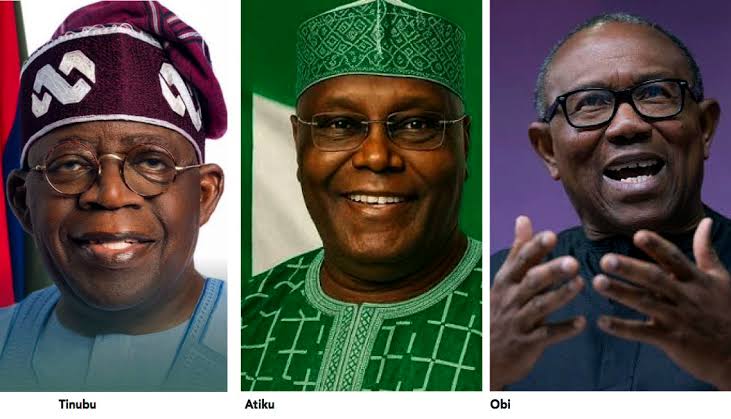
Barely 54 days before Nigeria’s January 16, 2027 presidential election, political activities are gathering momentum as major contenders intensify efforts to win the support of voters across the country.
Beyond party structures, campaign rallies, political alliances and the legal battles surrounding opposition parties, Nigeria’s political discourse is increasingly being shaped by slogans, catchphrases and expressions reflecting the ambitions, grievances and expectations of different political camps.
From Bamayi in Northern Nigeria, associated with former Vice President Atiku Abubakar of the African Democratic Congress (ADC), to ‘Rig and Die’, popularised by supporters of former Anambra State Governor Peter Obi of the Nigeria Democratic Congress (NDC), and President Bola Ahmed Tinubu’s ‘Àmàlàkàn’, the emerging political expressions have become part of the conversation ahead of the 2027 election.
Although the expressions differ in meaning, tone and political origin, they reflect the growing importance of identity, political messaging, public perception and voter mobilisation in Nigeria’s electoral contest.
With three prominent political figures seeking the presidency, the slogans are increasingly being used to communicate political positions, rally supporters and frame the debate around the country’s leadership.
From ‘Ba ma yi’ to Atiku’s northern appeal
One of the expressions attracting attention in the North is ‘Ba ma yi’, a Hausa phrase commonly translated as ‘we don’t want it’ or ‘we reject it’.
The expression has featured at political gatherings and protests in Northern Nigeria, including during President Tinubu’s campaign activities in Kaduna in October 2026.
A section of the crowd was reported to have chanted ‘Bamayi’ as the President’s convoy arrived at the campaign venue. The incident generated discussions about the administration’s acceptance in a region that has traditionally played a significant role in determining Nigeria’s presidential elections.
Although the chant is not an official campaign slogan of Atiku or the ADC, opposition supporters have increasingly used it to communicate dissatisfaction with the Tinubu administration and attract attention to the former Vice President’s political appeal in the North.
Atiku, who served as Vice President under former President Olusegun Obasanjo between 1999 and 2007, has remained a prominent figure in Northern Nigerian politics.
His political appeal is partly built around his longstanding presidential ambitions, experience in government and advocacy for economic restructuring and a more decentralised federation.
In the 2023 presidential election, Atiku contested on the platform of the Peoples Democratic Party (PDP), finishing second behind Tinubu. Peter Obi came third in that election.
For 2027, Atiku is contesting under the ADC, following the political realignments and opposition coalition arrangements that reshaped the country’s political landscape.
The former Vice President and his supporters have sought to turn public dissatisfaction over economic hardship, insecurity and the rising cost of living into a broader political argument against the ruling APC.
However, the significance of ‘Ba ma yi’ as an electoral expression remains open to interpretation. Chants at individual rallies or political gatherings cannot, on their own, establish the position of the entire Northern electorate.
The region is politically diverse, with competing interests among its states, ethnic groups, religious communities and political leaders. Consequently, the extent to which the expression translates into votes will depend on the ability of political parties to mobilise voters beyond rallies and social media.
‘Rig and Die’: The politics of electoral resistance
Another expression gaining prominence ahead of the election is ‘Rig and Die’, associated with supporters of Peter Obi and the wider Obidient political movement.
The slogan reflects growing concerns among some opposition supporters about electoral manipulation, ballot snatching, vote buying and the credibility of election results.
Its emergence also draws attention to Nigeria’s history of disputed elections and the longstanding demand for credible electoral processes.
Since the return to democratic rule in 1999, Nigerian elections have repeatedly been accompanied by allegations of electoral malpractice, violence and irregularities.
The 2007 general election, for instance, attracted widespread criticism over the conduct of the polls. Former President Olusegun Obasanjo had famously described the election as a ‘do-or-die’ affair, an expression that became part of the country’s political vocabulary.
The 2011, 2015, 2019 and 2023 elections also generated debates about the effectiveness of electoral safeguards, the role of security agencies and the credibility of results.
In 2023, the introduction of the Bimodal Voter Accreditation System (BVAS) and the INEC Result Viewing Portal (IReV) raised expectations about improved transparency in the electoral process. However, controversies surrounding the electronic transmission and uploading of results generated criticism from opposition parties and sections of the electorate.
Against this background, ‘Rig and Die’ has emerged as a particularly forceful expression of opposition supporters’ determination to resist electoral manipulation.
The slogan has also attracted controversy because of its potentially violent interpretation.
Former Deputy Senate President Ovie Omo-Agege reportedly warned at a political gathering in Delta State that anyone who attempted to rig the 2027 election could be killed.
Obi also used the expression ‘we will rig those who rig it’ while discussing electoral integrity, a statement that generated reactions in the political space.
INEC has consequently cautioned political actors against the use of the ‘Rig and Die’ rhetoric, warning that inflammatory statements could expose innocent Nigerians, including electoral officials, party agents and observers, to violence.
The commission has urged politicians to channel electoral grievances through lawful institutions, including the courts and relevant security agencies.
For Obi and his supporters, the debate surrounding the slogan is closely connected to their demand for electoral accountability and a credible voting process.
Nevertheless, the challenge for political leaders and their supporters is to ensure that the determination to protect votes does not translate into threats, intimidation or violence against citizens.
Tinubu’s ‘Eyin Lokan’: From ‘my turn’ to ‘your turn’
For President Tinubu, the latest political expression is ‘Eyin Lokan’, a Yoruba phrase meaning ‘it is your turn’.
The slogan represents a shift from the popular ‘Emi Lokan’ expression that defined his 2023 presidential campaign.
Tinubu introduced the new expression on Sunday, November 22, 2026, during a special prayer gathering organised by his extended family at the Yoruba Tennis Club in Onikan, Lagos.
Recalling his 2023 campaign message, the President said: “In the year 2022, I invoked ‘Emi lokan’, it’s my turn. Today, ‘Eyin lokan,’ it’s your turn.”
He also urged his supporters to mobilise Nigerians to collect their Permanent Voter Cards (PVCs) and participate in the January 2027 election.
“You must knock on your neighbour’s door and tell them to go and collect their PVCs,” he said.
The development is significant because ‘Emi Lokan’ became one of the defining expressions of Tinubu’s journey to the presidency in 2023.
The phrase, which means ‘it is my turn’, was first popularised during his campaign for the APC presidential ticket in 2022, particularly when he made his case to succeed former President Muhammadu Buhari.
At the time, Tinubu used the expression to remind party stakeholders of his contributions to the emergence of Buhari as President in 2015 and his subsequent re-election in 2019.
However, his latest ‘Eyin Lokan’ message places the emphasis on voters rather than his personal presidential ambition.
The President’s re-election campaign is taking place against the background of major economic reforms introduced since he assumed office in May 2023.
His administration’s removal of the petrol subsidy and foreign exchange reforms have attracted both support and criticism.
While the government has argued that the measures are necessary to stabilise the economy, Nigerians continue to contend with the effects of high living costs, expensive transportation, food inflation and insecurity.
Tinubu’s challenge is therefore to convince voters that his administration’s economic policies are delivering sufficient benefits to justify another four-year term.
The new slogan could serve as a vehicle for communicating that argument, while encouraging supporters to take responsibility for mobilising voters.
The political history behind Nigeria’s election slogans
Nigeria’s political history shows that campaign slogans have often played important roles in communicating candidates’ ambitions and connecting political parties with voters.
In the 1999 general election, the PDP’s campaign was built around the promise of a return to democratic governance following years of military rule.
The party subsequently dominated national politics for 16 years before losing power to the APC in 2015.
In 2015, former President Muhammadu Buhari’s campaign was largely associated with the promise of change, which resonated with voters dissatisfied with the administration of former President Goodluck Jonathan.
The APC’s ‘Change’ message became a major feature of the election that produced Nigeria’s first democratic transfer of power from an incumbent ruling party to the opposition.
In 2019, Buhari sought re-election under the ‘Next Level’ campaign, promising to consolidate the achievements of his first administration.
By 2023, the political messaging had taken a different direction.
Atiku’s ‘Recover Nigeria’ campaign focused on rescuing the country from economic and security challenges, while Obi’s supporters popularised the Obidient movement, built around demands for political change, accountability and improved governance.
Tinubu, meanwhile, campaigned under the ‘Renewed Hope’ banner, alongside his now-famous ‘Emi Lokan’ expression.
The 2027 election is therefore emerging with a fresh collection of political expressions, some of which are rooted in regional identity, while others are centred on electoral integrity and the President’s quest for another term.
Opposition divisions and the battle for political support
Beyond the slogans, the 2027 election is also taking place amid significant changes in Nigeria’s opposition politics.
The emergence of the ADC as a major opposition platform followed efforts by opposition figures to build a coalition capable of challenging the APC.
However, the inability of prominent opposition figures to consolidate around a single presidential candidate has created a different political landscape.
Atiku is contesting under the ADC, while Obi is seeking the presidency on the platform of the NDC.
Both were prominent contenders in the 2023 election, when they collectively secured substantial support against Tinubu.
The opposition’s legal and political challenges have also added another dimension to the contest. A recent Federal High Court ruling challenging the legality of the ADC leadership and Atiku’s candidacy has introduced further uncertainty, although the party has indicated its intention to appeal.
Meanwhile, Tinubu is seeking a second term under the APC, relying on the party’s national political structure and its campaign machinery.
INEC’s published list of presidential candidates also includes other contenders, among them Oyo State Governor Seyi Makinde of the Allied Peoples Movement (APM), Omoyele Sowore of the African Action Congress (AAC) and Adewole Adebayo of the Social Democratic Party (SDP).
The presence of multiple candidates means the election will not be restricted to the three prominent political figures and their supporters.
Beyond the slogans or Phrases: What will matter on election day?
As the January 16, 2027 election approaches, the emerging slogans provide a window into the competing political narratives surrounding the contest.
‘Ba ma yi’ reflects expressions of dissatisfaction with the ruling party in parts of Northern Nigeria, while ‘Rig and Die’ highlights concerns about electoral integrity and the determination of some opposition supporters to defend the ballot.
On the other hand, ‘Eyin Lokan’ represents Tinubu’s attempt to transform the personal ambition associated with his 2023 campaign into a message of voter participation and support for his second-term ambition.
However, political slogans alone cannot determine the direction of an election.
The country’s economic situation, security challenges, party structures, regional alliances, candidates’ records, voter turnout and credibility of the electoral process will remain important issues.
The North, in particular, will be a significant political battleground because of its voting population and historical influence on presidential elections. The South-West, Tinubu’s political stronghold, and the South-East, where Obi has considerable political appeal, will also attract attention.
Ultimately, the effectiveness of the slogans will be measured not by the noise they generate at rallies or their popularity on social media, but by whether they translate into sustained political mobilisation and votes.
For now, as the countdown to January 16 continues, Nigeria’s political atmosphere is increasingly being defined by three competing messages: rejection, resistance and a call for another mandate.
The question is whether these expressions will remain campaign sound bites or become defining narratives of the 2027 presidential election.