


By Moses Olili
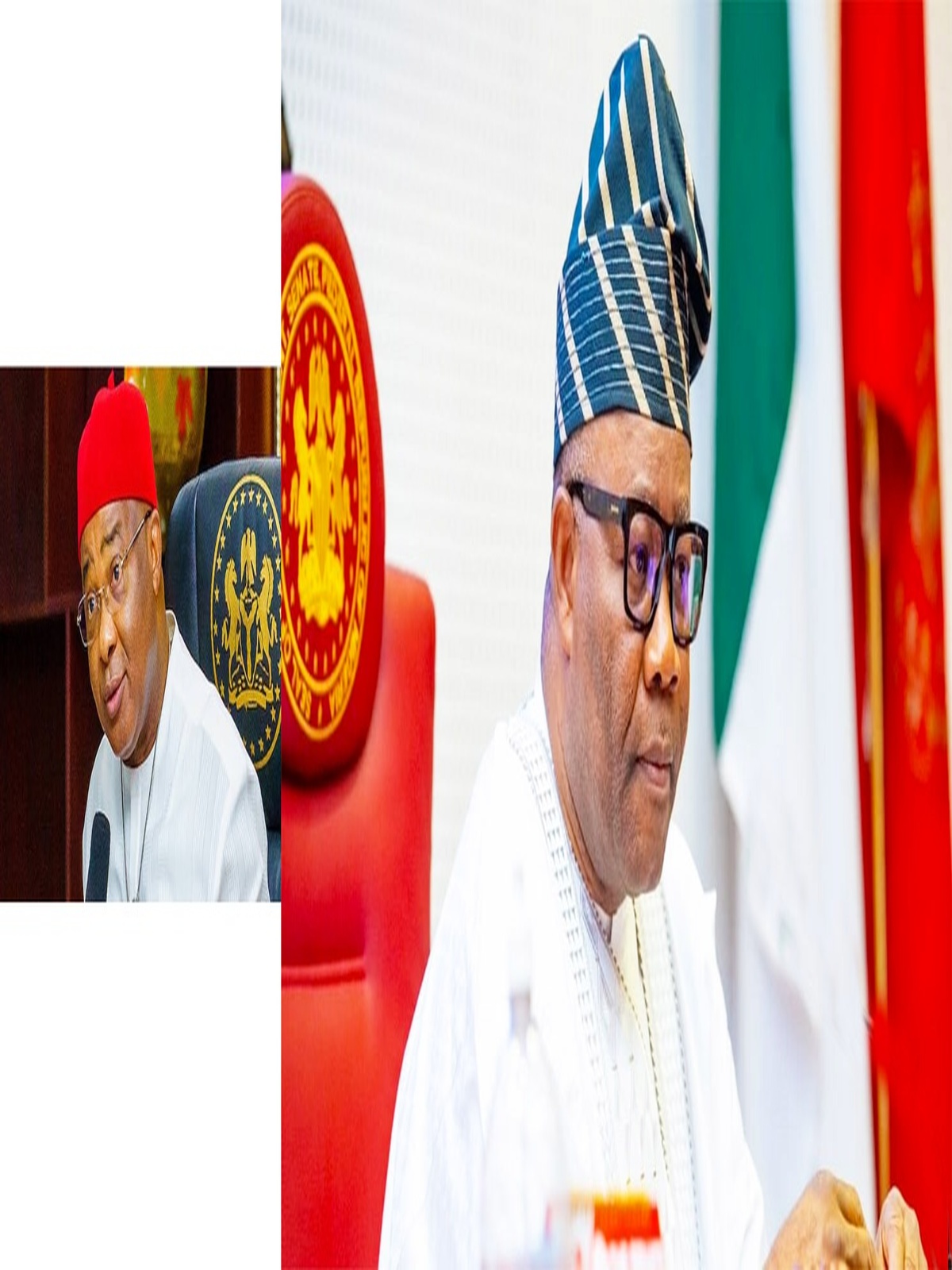
Imo State Governor Hope Uzodimma’s bid to return to the Red Chamber before his tenure expires has raised fresh questions about political ambition, constitutional limits and succession.
More so, speculation that Uzodimma could, upon returning to the Senate, seek to replace the incumbent Senate President, Godswill Akpabio, has become increasingly troubling.
First, there is something unusual about a man seeking a new job while he still has months left in the one he was elected to do.
That, in simple terms, is the curious position Governor Uzodimma of Imo State finds himself in. Uzodimma is still the governor of Imo State, with his second and final term not due to expire until January 2028. Yet, before the people who elected him as governor have finished counting the months left on his mandate, he is already asking voters in Imo West to send him back to the Senate.
There is, of course, nothing inherently strange about a politician seeking another elective office. Politicians leave one office and contest another all the time. But Uzodimma’s case is different because of the timing. If he wins the Imo West senatorial election in 2027, the new Senate is expected to be inaugurated in June of that year—roughly seven months before his tenure as governor expires.
And suddenly, what looked like an ordinary political ambition becomes a rather extraordinary dilemma. Uzodimma cannot be in Owerri governing Imo State and, at the same time, sit in Abuja as a senator representing Imo West. One mandate would have to give way to the other.
So, what exactly is the governor betting on? Is this simply a carefully calculated plan to secure his political future after Government House, or does it point to a bigger ambition that requires him to leave office earlier than the electorate originally expected? More importantly, what happens to the mandate he still holds when the Senate comes calling?
Those questions have turned Uzodimma’s bid to return to the Red Chamber into far more than another election story. It is a political gamble wrapped in a constitutional puzzle—and one that could have consequences not only for the governor but also for the future political direction of Imo State.
A Political Gamble With a Constitutional Question
Uzodimma is no stranger to the Senate. He represented Imo West from 2011 to 2019 before becoming governor, meaning his latest ambition is essentially a return to familiar territory. What makes the move remarkable is not the office he is seeking, but the fact that he is seeking it while his current mandate is still running.
The Constitution does not expressly state that a sitting governor cannot contest a Senate election. Section 65 sets out the qualifications for membership of the National Assembly, while Section 66 provides specific grounds for disqualification. Section 183, meanwhile, restricts a serving governor from holding another executive office or paid employment.
The more difficult question, therefore, is what happens if Uzodimma wins. Can he simply move into the Senate while remaining governor, or would he have to relinquish Government House before taking his seat in Abuja? That is where the political calculation becomes considerably more complicated.
If the new Senate is inaugurated in June 2027 and Uzodimma has won Imo West, he would still have roughly seven months left on his gubernatorial mandate. Should he resign to take up the Senate seat, he would be voluntarily bringing his tenure to an end before the period for which Imo voters elected him had elapsed.
That possibility raises an uncomfortable question about political mandates. A governor is elected to serve for a defined constitutional period, not merely until another attractive political opportunity comes along. While Uzodimma is entitled to pursue his political future within the law, voters are equally entitled to ask whether leaving office early in pursuit of another position amounts to putting political ambition ahead of an unfinished mandate.
The Succession Question
The issue does not end with Uzodimma’s decision. If he eventually chooses the Senate, attention will inevitably turn to who takes over Government House.
The Constitution provides for the deputy governor to assume the governorship when the office becomes vacant in circumstances prescribed by law. But in practical political terms, the question is far more consequential than the constitutional succession mechanism suggests.
Whoever inherits the office, even for a few months, would control the machinery of government at a crucial political moment. Uzodimma’s political structure would have to adjust to his departure, while politicians with their eyes on the next gubernatorial contest could begin positioning themselves for influence.
This is why reports and speculation surrounding the future of Deputy Governor Chinyere Ekomaru have attracted attention. Her office has dismissed reports that she was being pressured to resign, insisting that she remains in office and continues to perform her duties. While the denial should not be interpreted as proof of a succession plan, the speculation itself demonstrates how politically sensitive an early departure by the governor could become.
Okorocha Adds Another Layer
Uzodimma’s Senate ambition is also facing a challenge from a familiar political rival. Former governor Rochas Okorocha, who previously represented Imo West in the Senate, has gone to court over the emergence of Uzodimma as the APC candidate for the district.
Okorocha is challenging the outcome of the party’s senatorial primary and INEC’s recognition of Uzodimma as the candidate. The case adds another layer of uncertainty to an already unusual political contest and means the governor’s path back to the Senate is not entirely in his hands.
For now, therefore, Uzodimma has several hurdles to clear. He must first overcome the legal challenge, then win the senatorial election and, if successful, confront the question of whether he is prepared to abandon the remaining months of his gubernatorial tenure.
What Is Really Behind the Move?
The attraction of the Senate is not difficult to understand. Uzodimma has spent years at the centre of Nigerian politics, and a return to the National Assembly would allow him to remain influential after leaving Government House. His position as Chairman of the Progressive Governors’ Forum has also given him a prominent role within the ruling APC.
A Senate seat could therefore be more than a retirement destination. It could provide a platform for continued influence in national politics and potentially open the door to greater responsibilities within the National Assembly or the party. Speculation about higher political ambitions may be premature, but Nigerian politics has never been short of politicians using one office as a springboard to the next.
That may explain why Uzodimma appears unwilling to wait until January 2028 before securing his next political platform. In politics, waiting can be a gamble of its own. Alliances change, political structures shift and opportunities disappear. By seeking the Senate now, the governor may simply be ensuring that he has somewhere to land when his time in Government House eventually ends.
But that strategy comes with a price: he may have to choose between the office he currently holds and the one he wants.
The Gamble Ahead
Ultimately, Uzodimma’s Senate bid is more than a story about a politician seeking a familiar office. It raises a broader question about how elected officials treat the mandates entrusted to them and where the boundary lies between legitimate political ambition and responsibility to the electorate.
The Constitution may not expressly prohibit a sitting governor from seeking a Senate seat, but the overlap in the two mandates creates a problem that political calculations cannot wish away. If Uzodimma wins, he cannot indefinitely govern Imo State from Owerri while simultaneously representing Imo West in Abuja.
At some point, a choice will have to be made.
For now, the governor is betting on the Senate, while Okorocha is challenging his path to the ticket in court. The APC and INEC are drawn into the unfolding dispute, while Imo voters watch a political drama that could ultimately determine not just who represents Imo West in the next Senate, but how the state is governed in the final months of Uzodimma’s tenure.
The real question, therefore, is no longer simply whether Uzodimma can return to the Senate.
It is whether he is prepared to leave Government House before his time is up to do so.
That is the gamble—and by 2027, the governor may have no choice but to show his hand.


